




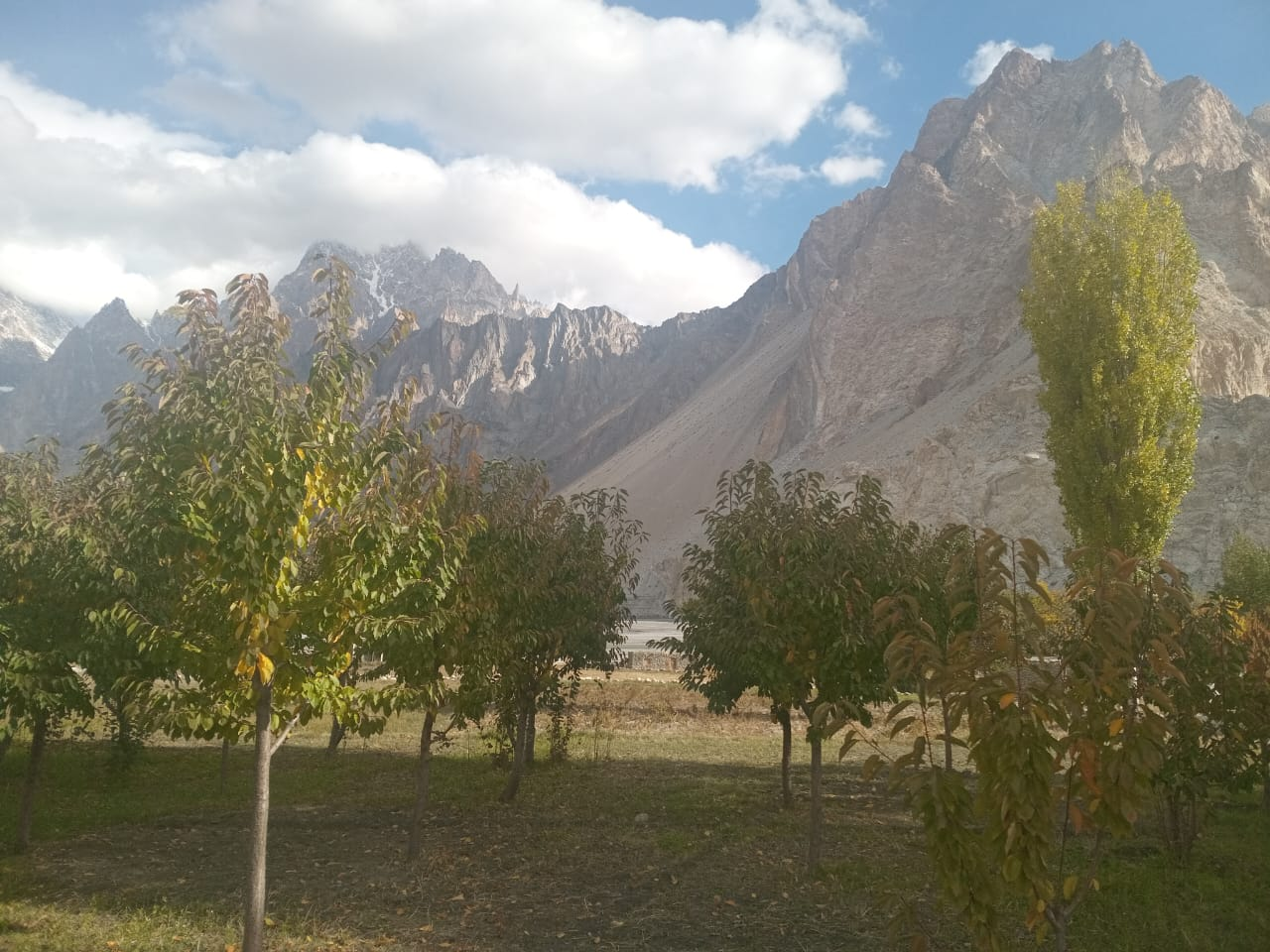
Drawing lessons from China’s mountain farming models, Muhammad Darjat explores how Gilgit-Baltistan can integrate climate-resilient agriculture, ecological restoration, clean energy and modern value chains to strengthen rural livelihoods, reduce post-harvest losses and build a sustainable mountain economy.
The high-altitude mountain regions of Pakistan face cumulative crises of ecological degradation, climate vulnerability, perennial threat of loss and damage from glacier outbursts and floods, food insecurity, use of wood for cooking and heating, fiscal dependency, child stunting, malnutrition, lack of reliable clean energy and youth unemployment and poverty as well.
In the mountainous ecology, specific environmental challenges include lack of preparation of community-led mini-watershed management plans that’s include budgeting climate adaptations actions and restoration of biodiversity habitats, ecosystems services. The high altitude mini-watersheds in the Karakorum and Hindukush are severely threatened by unmanaged runoffs due to abnormal cloudbursts, heavy rains, and rapid glaciers and snowmelt—leading to flash floods that leads to loss and damage of soil, livelihoods, built environment, farming and non-farming assets.
Nowhere is this more acute than in Karakorum and Hindukush and Himalaya Mountains, where rugged terrain, melting glaciers, and fragile slopes and soils limit mountain agricultural practices and per acre yields—output that traditionally complements household incomes. To secure rural livelihoods and protect fragile ecosystem services, the Gilgit-Baltistan government can look next door, eastward and learn the high-value resource management models pioneered in China’s mountainous provinces including Sichuan, Yunnan, Guizhou and Jiuzhaigou
Long term planning for Gilgit-Baltistan is a missing link and that could start through collaborations with technical service providers including engaging academia, development planning experts and specialized consulting firms those have their focus on climate change, off-grid clean energy, environment, economic growth, youth and women.
The present government of GB needs to undertake a contextual study that focuses on long-term planning exercises with the initial focus on physical resource mapping including glaciers, snow, rivers, wetland, soil, green cover including forest areas, agriculture land and barren spaces and the built environment. The exercises should also focus looking into trends in farming practice in the deep Valleys including pastures management, slopes and soil vulnerabilities and losses through digital tools and field missions and community consultations. Certainly, human resource mapping including human migration patterns should also be one of the key themes in the proposed contextual study.
The outcomes of study will help the policy makers for building plans and projects for good of the people and the planet.
During the contextual study of planning exercises in response to the challenges identified in this article, the need is also to examine three serious investments that were made during the past 40 years in GB. The Aga Khan Rural Support Programme (AKRSP) model was initiated under the leadership of founding general manager Shoaib Sultan Khan that focused on immediate income generation activities at households’ level and IFAD funded EIT project that promoted farmers cooperatives around specialized high value products.
China transformed its once-impoverished mountainous regions through targeted ecological restoration coupled with commercial agricultural modernization. Instead of treating mountain communities as passive inhabitants, the policy integrates them as active partners of natural resources through eco-compensation mechanisms, where local farmers receive financial incentives from the state to shift away from undesirable practices like overgrazing and deforestation, redirecting their labor toward ecological conservation and high-value niche farming.
At the heart of this transformation is a rigorous, end-to-end value chain framework applied directly to GB’s core horticultural assets—specifically apricots, apples, cherries, pears, peaches, and seed potatoes. High-altitude cultivation thrives in semi-arid, temperate mountain valleys—such as Gilgit-Baltistan, Chitral. China’s Sichuan, Yunnan, and Guizhou provinces—where deep diurnal temperature swings, high solar radiation, and mineral-rich glacial meltwater enhance natural fruit sweetness and dry matter content might offer learnings for the mountain farmers of GB. High-altitude seed potatoes, a critical cash crop, require certified disease-free tissue culture labs and cold-storage facilities managed at the community level. Modern orchard management relies on high-density planting, disease-resistant rootstocks, and careful pruning to maximize fruit sizing, followed by harvesting through precise maturity staging—picking firm-ripe fruit for fresh shipping or fully ripe fruit for processing using drop sheets to prevent bruising.
In China, fresh fruit is rapidly sorted post-harvest by size, color, and sugar content, then immediately pre-cooled to remove field heat and extend shelf life before cold transport. For longer preservation, produce is stored in specialized cold facilities at required temperatures relative humidity and controlled oxygen levels, allowing fresh fruit to be preserved for weeks for regional markets. To tackle severe post-harvest loss rates—which plague perishable fruits like cherries and apricots—yields could be systematically channeled into modern solar-drying units to preserve vibrant orange color, or organic sun-drying on clean wooden racks and stone platforms, followed by mechanical pitting and moisture stabilization. Furthermore, lower-grade fruit could be converted into high-value secondary commodities, including cold-pressed apricot kernel oil for cosmetics and culinary uses, ground kernel meal for livestock feed or bitter almond extracts, purees for infant nutrition.
Finished goods can then be vacuum-sealed, packed in nitrogen-flushed barrier bags or aseptic cartons, and distributed through cold-chain logistics to domestic retail hubs and international markets. In the mountainous areas of Pakistan, for the past at least forty years at a micro-level these ideas have been tried, tested but the business at high scale is missing due to many constraints. And lack of generating and supplying reliable energy is the core constraint and that could be resolved with investment in captive energy in a selective watershed where there is also potential for growing high value agriculture products.
China offers at least six relevant models for replication in GB.1) Sichuan and Yunnan shifted from traditional crops to high-value organic cherries, seed potatoes, and walnuts, a model can be adapted to capture retail margins. 2) Sichuan’s e-commerce training and Yunnan’s cooperative-led training in processing and hospitality offer blueprints to establish digital hubs and curb brain drain of youth. 3) Guizhou and Sichuan combined sloping-land conversion with community-based disaster risk reduction, providing critical frameworks to enhance resilience of both community and the ecosystem services. 4) Guizhou’s low-impact ropeways and rugged Chinese provinces’ solar cold-storage networks show, how to connect remote areas and reduce post-harvest losses. 5) Sichuan pioneered upper-watershed eco-compensation, while Jiuzhaigou used strict ecotourism zoning—strategies can be useed for carbon credits and environmental protection. 6) Yunnan and Sichuan’s off-grid micro-hydro and solar mini-grids backed by Guizhou’s green micro-loans promotes agro-processing and rural entrepreneurships which offers another example for replication in our part of the world.
This commercial momentum would be amplified by green logistical connectivity supported by the infrastructure established through the China-Pakistan Economic Corridor (CPEC), providing a direct conduit to high-value urban markets in mainland Pakistan and western China. Establishing modern cold-storage networks, refrigerated transport fleets, and multi-purpose collection hubs across districts like Gilgit, Ghezir, Hunza, Nagar, Skardu, and Guanche bridge the physical gap between remote mountain orchards and international consumers.
Institutionalizing this partnership to bridge the gap between policy and field implementation requires a serious institutional linkage between Pakistani agrarian universities, Gilgit-Baltistan ‘s local governance, and Chinese agricultural research academies. Establishing joint demonstration zones can showcase climate-resilient farming techniques, advanced post-harvest sorting, and organic certification protocols directly to local farmers.
By embracing the Chinese philosophy that ecological health and economic vitality must go hand in hand, Gilgit-Baltistan can turn its geographic vulnerabilities into a thriving, sustainable mountain economy.