




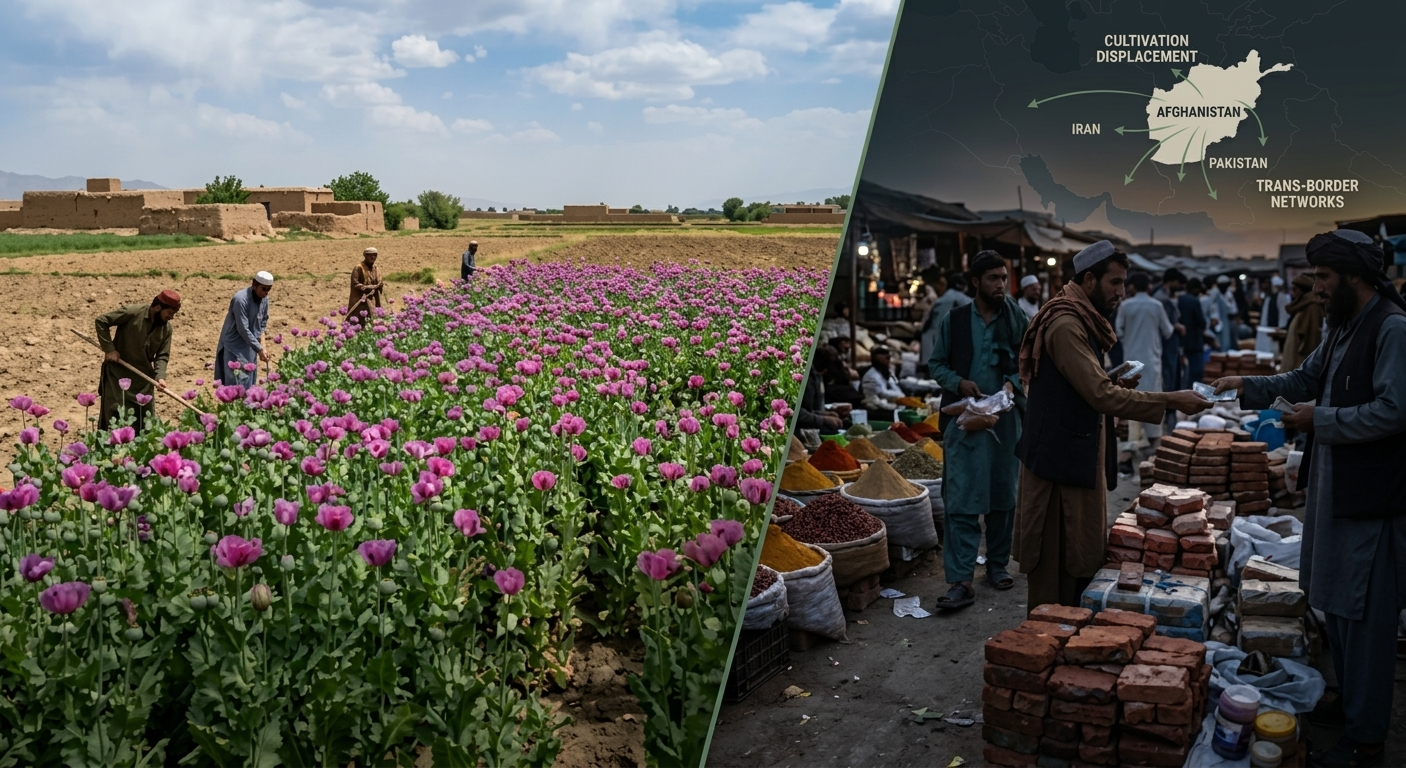
The Taliban’s narcotics ban initially brought poppy cultivation to historic lows. A fivefold rebound in production in 2026, however, reveals how farmers, traffickers and illicit networks are adapting within Afghanistan and across its borders.
Afghanistan’s poppy fields shrank dramatically following the Taliban’s April 2022 narcotics ban. Yet in Helmand, one of the country’s former opium heartlands, markets remain active in Sangin and Musa Qala. Traders and residents interviewed by Hasht-e Subh alleged that Taliban commanders and officials were investing in the business, including buying and selling stocks accumulated before the ban.
The latest figures suggest that the ban’s initial success is becoming increasingly difficult to sustain. According to the United Nations Office on Drugs and Crime’s (UNODC) Afghanistan Opium Survey 2026, released on 29 October, poppy cultivation increased by approximately 330 per cent, from 10,200 hectares in 2025 to more than 43,000 hectares in 2026. Estimated opium production rose by around 400 per cent, from 296 tonnes to nearly 1,500 tonnes. Cultivation also spread from 11 to 16 of Afghanistan’s 34 provinces. Although these figures remain considerably below the 232,000 hectares cultivated in 2022, they mark the first substantial reversal of the decline that followed the ban.
The geographical shift is equally significant. Badakhshan and Takhar in Afghanistan’s northeast now account for approximately 76 per cent of the country’s poppy cultivation, displacing the traditional southwestern heartlands. In Badakhshan alone, cultivation expanded from approximately 6,600 hectares in 2025 to nearly 29,500 hectares in 2026. UNODC also documented farmers concealing poppy plots among cereal crops or inside walled compounds to evade enforcement. The Taliban authorities have disputed the survey’s findings, maintaining that extensive eradication operations have substantially reduced cultivation.
The resurgence complicates the earlier narrative of a successful prohibition. Substantial opium stockpiles, changes in heroin processing and expanding cultivation in neighbouring Pakistan and Iran have helped sustain regional supplies during the years of reduced Afghan production. As the European Union Drugs Agency (EUDA) observed, the region’s drug economy has demonstrated considerable resilience through the displacement of cultivation, shifts in production methods and the continued availability of stored opium. With fresh cultivation recovering, the illicit economy is undergoing another adjustment rather than disappearing.
The question, then, is who stands to benefit. A farmer losing opium income, a trader with stocks still to sell and a landowner renting out fields across the border have very different stakes in the ban. How they respond will help determine whether enforcement weakens trafficking networks or gives them new places to do business.
Within Afghanistan, the distribution of stored opium has been uneven. Inventories have cushioned some landowning farmers and traders in the southwest against lost income. Poorer households with little land or depleted stocks have fewer options. This complicates any simple division between impoverished farmers and wealthy traffickers: some producers have reserves to draw down, while others must find work, borrow or cultivate elsewhere.
Across the border, that last option is becoming more visible. Satellite analysis by Alcis identified more than 9,000 hectares of poppy cultivation in Pakistan’s Balochistan province in 2025. Newer imagery suggests further expansion in 2026, as well as cultivation in Iran’s Sistan-Baluchistan province. The significance lies partly in the movement of people and expertise. Restrictions on Afghan farmland have not erased growers’ knowledge or their connections to buyers.
Afghan farmers are leasing land or entering sharecropping arrangements in neighbouring countries, bringing capital and cultivation experience. Local landowners gain access to a profitable crop, while Afghan growers retain a stake in the business. Pakistan disputes the scale of cultivation: Islamabad maintains that discovered crops have been eradicated, while a Killa Abdullah official said cultivation had declined following an eradication campaign. UNODC has cautioned that data from Afghanistan’s neighbours remain scarce.
For Pakistan, the security implications require attention to where this activity is occurring and who facilitates it. Loralai and Killa Abdullah have emerged as major cultivation areas. The fact that these districts are in Balochistan does not, by itself, connect their opium economy to the province’s separatist insurgency. A growing trade could nevertheless create opportunities for officials, local brokers and armed actors able to demand payments or provide protection. Investigations need to establish those relationships rather than infer them from a provincial map.
The Tehrik-i-Taliban Pakistan (TTP) has expanded into Dera Ismail Khan and Lakki Marwat, districts with established drug-trafficking networks. Conflict monitor ACLED assesses that the group has sought to tap these networks for recruitment. This warrants scrutiny of how militant influence overlaps with illicit commerce. It does not establish that the TTP receives revenue from the newly documented fields in Balochistan. That would require evidence of payments, ownership or control over shipments.
Methamphetamine is harder still to track. Production can take place inside residential compounds, making laboratories difficult to distinguish from civilian buildings through satellite imagery. A crop survey can capture the disappearance or return of poppy fields while revealing little about synthetic drug production. Alcis’s satellite analysis has also identified an expansion in ephedrine laboratories in Balochistan, evidence that production of a key methamphetamine ingredient is spreading across the border.
Iran’s seizure figures offer another indication of the trade’s reach. Iranian officials reported intercepting 3,663 kilograms of methamphetamine in five operations during the first half of 2026. They said the shipments originated in Afghanistan and were intended for international markets.
The northern border is becoming particularly important. In July, Tajikistan’s Drug Control Agency reported seizures of 1,513 kilograms of narcotics along the Afghan frontier in the first six months of 2026, alongside seven armed confrontations with suspected smugglers. The volume was below the corresponding figure for 2025. It demonstrates continued trafficking, although seizure totals alone cannot establish whether the overall flow is rising or falling.
The latest UNODC findings give this northern dimension greater significance. Approximately 85 per cent of Afghanistan’s poppy cultivation now occurs in provinces bordering Central Asian countries. With Badakhshan and Takhar emerging as the principal cultivation centres, the proximity of production to Tajikistan and other northern markets could create opportunities for traffickers operating along established routes. This geographical concentration does not establish that narcotics shipments through Central Asia have increased, but it strengthens the case for monitoring how production and trafficking patterns interact.
Afghanistan’s changing commercial geography adds another reason to watch this frontier. With major crossings into Pakistan remaining closed to trade, legitimate commerce has become increasingly dependent on routes through Iran and Central Asia.
This shift raises a question about whether established trafficking networks will seek greater access to northern routes. It does not establish that Pakistan’s border closures have diverted narcotics through Central Asia, and lawful trade should not be treated as suspect simply because it uses those corridors. The useful response is closer examination of trafficking patterns as commercial routes change, without obstructing the legal markets Afghan farmers need.
Regional governments already have mechanisms on which to build. In March, the Shanghai Cooperation Organisation Secretariat and the Central Asian Regional Information and Coordination Centre signed a memorandum on counternarcotics cooperation. Its practical value will depend on whether agencies exchange usable information about trafficking networks and emerging production, including when wider political relations are strained.
Such cooperation also needs a clearer purpose than producing larger seizure totals. Financial investigations could help identify who funds cultivation, owns stocks and profits from transport. Comparing drug prices and the composition of seizures across borders would help assess whether enforcement is reducing supply or pushing activity elsewhere. Allegations involving officials deserve the same scrutiny as claims about militant financing.
The rural economy remains central to whether any gains last. According to UNODC’s 2025 survey, farmers’ income from opium sales fell by 48 per cent, from $260 million in 2024 to $134 million in 2025. The market nevertheless remains lucrative. UNODC’s latest findings estimate that opium sales generated approximately $525 million for traders in 2026, while average prices remained around $500 per kilogram – more than five times their pre-ban level.
The rebound, however, should not be mistaken for an improvement in rural livelihoods across Afghanistan. Across the four provinces UNODC monitored for land use – Farah, Helmand, Kandahar and Nangarhar – 41 per cent of farmland was fallow in 2025. In Badakhshan, eradication operations that year met resistance, with civilian casualties reported. Farmers’ grievances are already a governance problem, without needing to be recast as evidence of militant recruitment.
The 2026 resurgence demonstrates the limits of relying on prohibition without addressing the conditions that make illicit cultivation profitable. Livelihood assistance will have to address what makes legal farming viable: reliable water, affordable credit and access to buyers. Closing markets for lawful crops while demanding that farmers abandon opium works against that objective.
A durable reduction in the drug economy also requires action against the financiers and intermediaries who can survive a failed harvest or move their business elsewhere. Otherwise, the ban risks leaving the poorest farmers to bear its costs while better-resourced actors carry the trade across the next border.
Ultimately, containing the illicit drug economy requires regional cooperation that extends beyond seizures and border enforcement. Governments must target trafficking networks while enabling legitimate cross-border trade, investment in agriculture and reliable market access for farmers. Without profitable alternatives to opium, prohibition may continue to change the geography of the trade without dismantling the economic incentives sustaining it.