




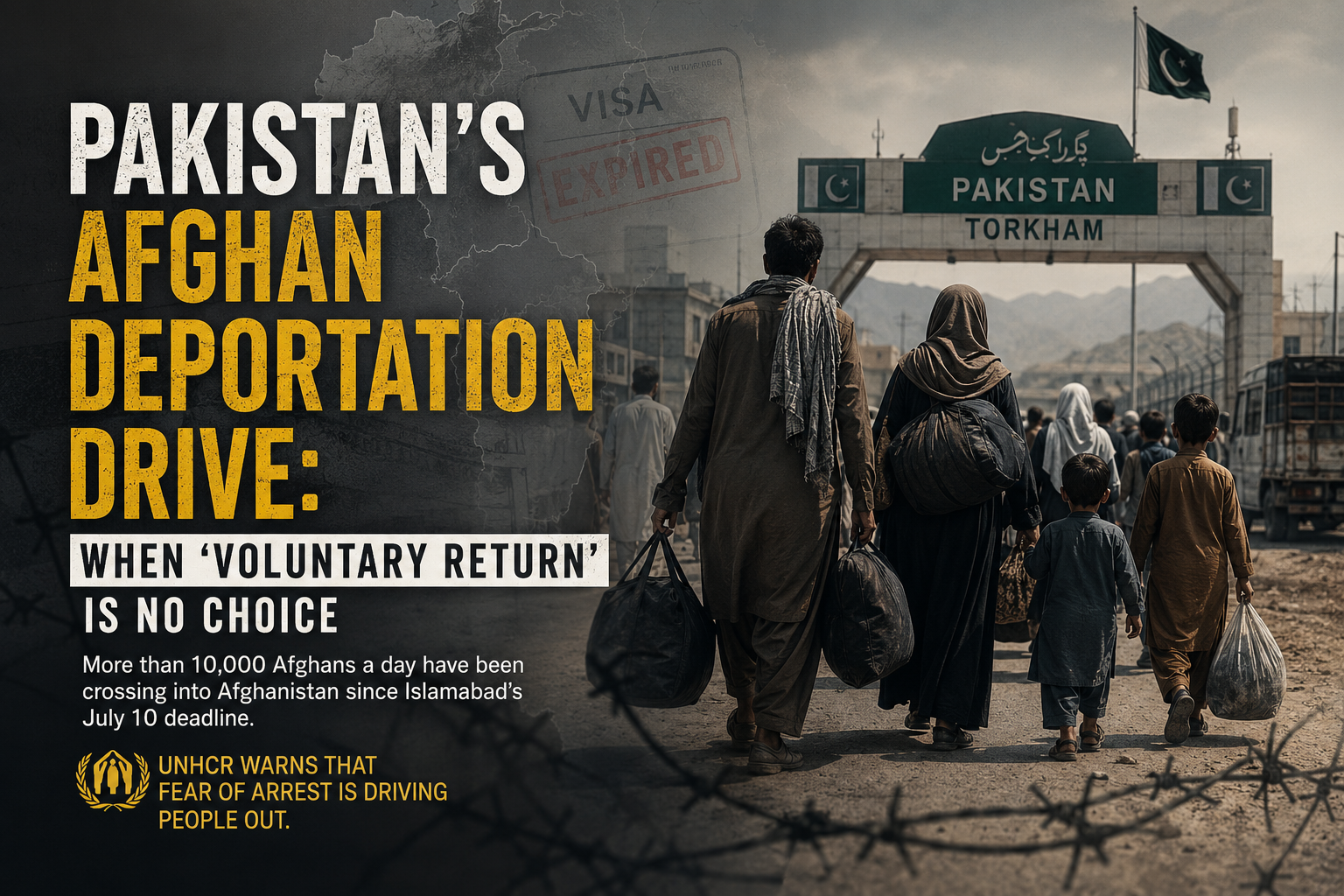
More than 10,000 Afghans a day have been crossing into Afghanistan since Islamabad’s July 10 deadline. The UN warns that fear of arrest is driving people out, blurring the line between voluntary return and forced deportation.
Days before Pakistan’s latest deadline for Afghans expired, a holding centre at a government college in Rawalpindi was fortified with barbed wire, CCTV cameras and searchlights. Fifty-five police officers were assigned to guard it in three shifts, alongside Elite Force commandos. Afghans brought to the centre were required to surrender their mobile phones at a verification desk until their deportation.
The arrangements offered an early picture of what would follow July 10, the date after which Pakistan’s Interior Ministry ordered the immediate arrest of any Afghan national found in the country without a valid visa.
The crackdown is now under way. On July 12, police detained 47 Afghans in Charsadda district and three more in neighbouring Mohmand. The detainees were transferred to holding facilities for verification before deportation through the Torkham border. Authorities in Punjab say 36 holding centres are operating across the province. Dawn reported the first arrests under the renewed operation.
At the border, the scale of the movement is even more visible. Officials at the Hamza Baba transit point in Landi Kotal said more than 10,000 Afghans had been returning each day, nearly three times the rate recorded in May and June. In Kohat, state media reported that more than 12,200 families had left refugee camps through a phased return programme.
A return driven by fear
Pakistan describes the campaign as the enforcement of its immigration laws. The Interior Ministry’s directive applies to Afghans without valid visas, including those whose visas have expired, and requires authorities to submit daily reports on arrests and subsequent action. Islamabad argues that a sovereign state cannot indefinitely permit foreign nationals to remain without valid documentation.
Yet the surge at Torkham began before many of those crossing were physically detained. Local officials say Afghans with and without documents have been heading towards the border because they fear arrest. When a family leaves after being told that staying will lead to detention and deportation, can its departure meaningfully be called voluntary?
Official figures do not resolve the question because the categories are frequently blurred. UNHCR says around 2.56 million Afghans have returned from Pakistan since the Illegal Foreigners’ Repatriation Plan began in November 2023. Of these, about 260,000 were formally deported by immigration authorities. A Punjab government spokesperson, however, said this week that 2.59 million Afghans living in the country illegally had been deported since 2023.
The near-identical totals describe very different things. One counts a broad return movement and separates formal deportations. The other labels almost the entire movement as deportation. Afghans who cross the border to avoid arrest may be recorded as returnees even though coercion shaped their decision. UNHCR has warned that fear of arrest is contributing to the surge.
The policy also places people with very different protection needs under the same administrative label. Pakistan hosts undocumented migrants and visa overstayers, but also people holding Proof of Registration cards, Afghan Citizen Cards and asylum-seeker certificates. During the week from June 28 to July 4, UNHCR-IOM monitoring found that 49% of returnees were undocumented, 40% held Proof of Registration cards and 11% held Afghan Citizen Cards.
Pakistan is not a party to the 1951 Refugee Convention and has no national refugee law or formal state procedure for determining refugee status. Asylum seekers are generally treated under the colonial-era Foreigners Act of 1946, leaving temporary documents and changing executive policies to determine whether they can remain. UNHCR describes the resulting protection gap here.
However, there have been some efforts, albeit sporadic, to tackle such a gap. Two days before the deadline, the Peshawar High Court stopped the deportation of around 140 Afghan families and individuals who said they feared persecution. It ordered the federal government to assess their claims under the principle of non-refoulement, which prohibits returning someone to a place where they face serious threats. The court also barred their arrest or deportation while those decisions are pending.
The July 8 ruling protects the petitioners, but it does not create a screening process for the many others who may face similar risks.
Women and girls face particular danger
UNHCR has urged Pakistan to ensure that returns are voluntary, safe and dignified, warning that no refugee should be sent to a country where their life or freedom would be threatened.
The agency says women and girls face particular risks in Afghanistan, where the Taliban have barred girls from secondary school and university and excluded women from most employment and much of public life. UN Women estimates that 78% of young Afghan women are outside education, employment or training.
For a female student enrolled in Pakistan, a woman supporting a household alone or an activist who fled the Taliban after August 2021, deportation may mean the loss of education, income or personal safety. UNHCR has asked Islamabad to exempt such cases, along with journalists, human rights defenders, ethnic and religious minorities, artists and gender-diverse people with urgent protection needs.
Pakistan’s decades of hosting Afghans, often with limited international support, form an important part of the story. So do its right to manage migration and the strain placed on host communities. But neither removes the need to distinguish an immigration violation from a claim for protection, or a managed return from one secured through the threat of arrest.
At holding centres, the process is described through the language of administration: registration, verification, documentation and transfer. At the border, however, each entry in the return statistics represents a family deciding what to carry, what to abandon and whether the country across the frontier is safe for them.
After July 10, remaining in Pakistan is no longer a realistic option for Afghans without a valid visa. Calling their departure voluntary does not make it a free choice.