




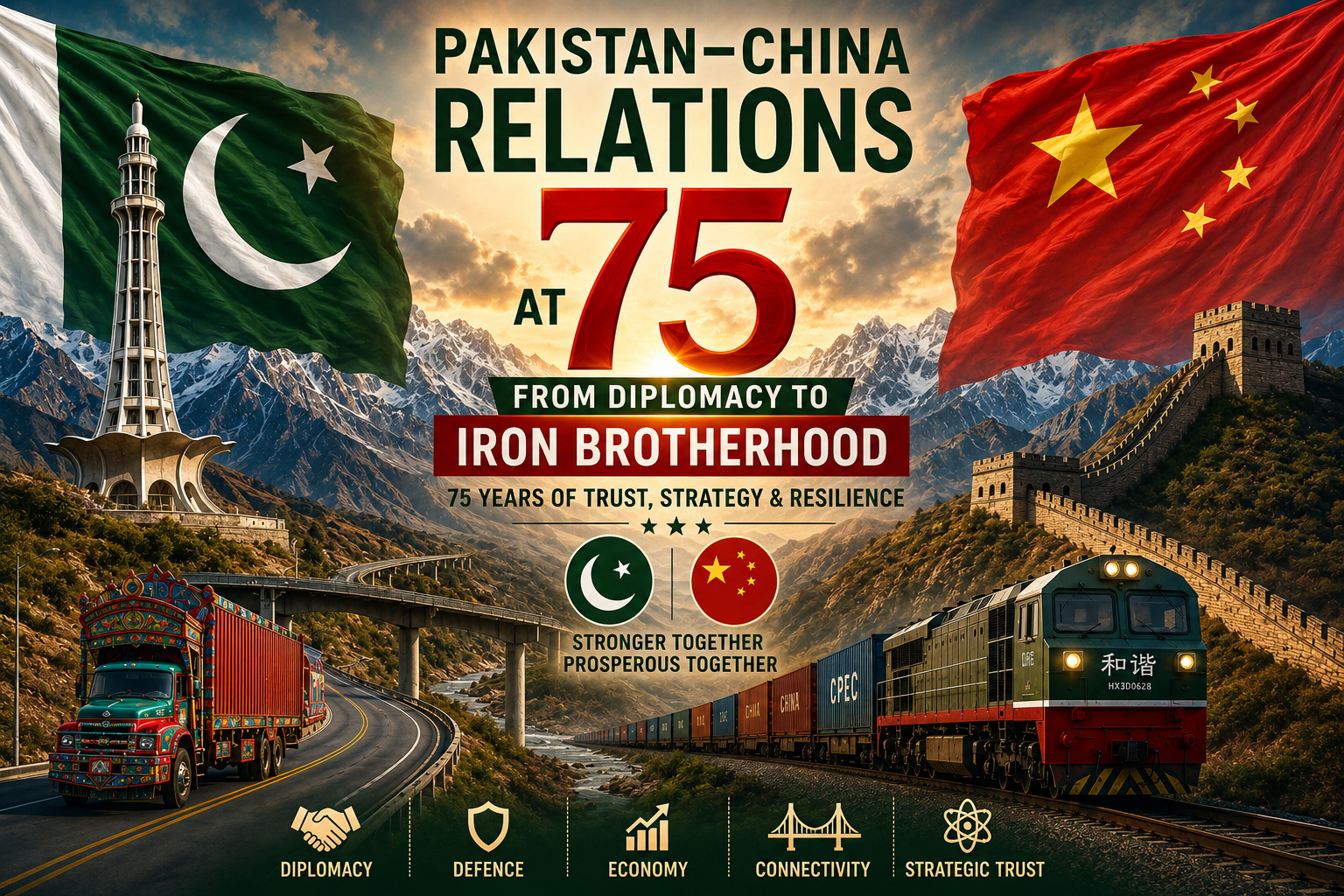
Seventy-five years on, Pakistan and China’s partnership stands as a rare example of trust, strategy, and resilience in a changing world.
China and Pakistan officially established diplomatic relations in 1951, and the relationship marks 75 years of what both countries often describe as an “iron brotherhood.” When ties were first established, neither country occupied the strategic position it holds in global affairs today. Over the decades, however, the relationship evolved from a cautious diplomatic engagement into one of the most durable strategic partnerships in contemporary international politics. Built on mutual respect, sovereign equality, and long-term trust, the partnership has survived changing geopolitical realities and regional instability.
Even before the formal establishment of relations, interactions between leaders of both sides had begun. In 1942, Quaid-e-Azam Muhammad Ali Jinnah met Chinese Nationalist leader Chiang Kai-shek. At the time, neither side could have predicted that Pakistan and China would eventually become close strategic partners. Yet history took a different course, and the relationship gradually transformed into a partnership driven by shared interests and regional realities.
One of the major factors that brought both states closer was the common challenge posed by India. Pakistan and China both fought wars with India at different moments in history, and this strategic convergence pushed the two neighbors toward deeper cooperation. For Pakistan, maintaining stable relations with China became a geopolitical necessity. Already engaged in a prolonged rivalry with India, Pakistan could not afford hostility on another border. While relations with Western powers remained important, geography ultimately favored a stronger partnership with China. Unlike distant allies, China was a neighboring power with growing regional influence.
The relationship also matured through diplomatic cooperation during critical moments of the Cold War. Pakistan supported China’s return to its lawful seat at the United Nations in early 1970s and later played an important role in facilitating the diplomatic opening between the United States and China. Islamabad acted as a quiet bridge between Washington and Beijing, helping pave the way for the historic rapprochement between the two global powers. This diplomatic trust strengthened the foundation of Pakistan-China relations.
Beyond public diplomacy, there were several hidden dimensions that deepened the partnership. One of the most significant was the transfer of the Shaksgam Valley. Unlike many territorial disputes that lead to prolonged conflict, Pakistan and China resolved their border issues through negotiation. Pakistan handed over control of the strategically important Shaksgam Valley to China under the 1963 Sino-Pakistan Boundary Agreement. The region connects China with Pakistan-administered Kashmir and lies close to India’s northern borders. The agreement not only settled territorial concerns but also laid the groundwork for long-term strategic coordination between the two countries.
Another important pillar of the relationship was nuclear cooperation. Over the years, China played a crucial role in supporting Pakistan’s civilian and strategic nuclear capabilities. For Pakistan, nuclear development was viewed as essential for maintaining strategic balance in South Asia. Chinese assistance in technology, infrastructure, and expertise strengthened bilateral trust and expanded cooperation beyond diplomacy and trade into the security domain.
The construction of the Karakoram Highway further transformed the relationship. Often described as a symbol of Pakistan-China friendship, the highway connected Pakistan’s northern areas with China’s Xinjiang region through one of the world’s most difficult mountain terrains. More than an infrastructure project, it became a strategic corridor linking the two countries economically and militarily. The road later provided China with greater access toward the Arabian Sea and Indian Ocean, increasing Pakistan’s significance in Beijing’s regional connectivity ambitions.
In recent years, the China-Pakistan Economic Corridor (CPEC) emerged as the flagship of bilateral cooperation under China’s Belt and Road Initiative. While CPEC promised investment, infrastructure development, and energy projects, it also revealed contradictions. Questions regarding debt sustainability, provincial inequalities, transparency, and security challenges generated domestic debate within Pakistan. Nevertheless, despite criticism and delays, CPEC remains central to the economic dimension of Pakistan-China relations.
The military dimension of the partnership has also expanded significantly. Joint military exercises, defense production, intelligence cooperation, and arms transfers have strengthened strategic coordination between the two countries. China has become Pakistan’s largest defense partner, reflecting the growing depth of security cooperation in an increasingly uncertain regional environment. The recent Pakistan-India confrontation in May 2025 reassured the credibility of Chinese hardware. For China, the conflict became a live demonstration of its systems against advanced Western and Russian platforms.
After 75 years, Pakistan-China relations continue to evolve beyond traditional diplomacy. The partnership is no longer limited to strategic balancing; it now includes trade, infrastructure, technology, defense, and regional connectivity. As global politics enters a new phase of competition and uncertainty, both countries are likely to deepen cooperation further. The future of the relationship will depend not only on shared strategic interests but also on how effectively both states manage economic challenges, regional tensions, and changing global dynamics. For now, the Pakistan-China partnership remains one of the most enduring alliances in Asia.