




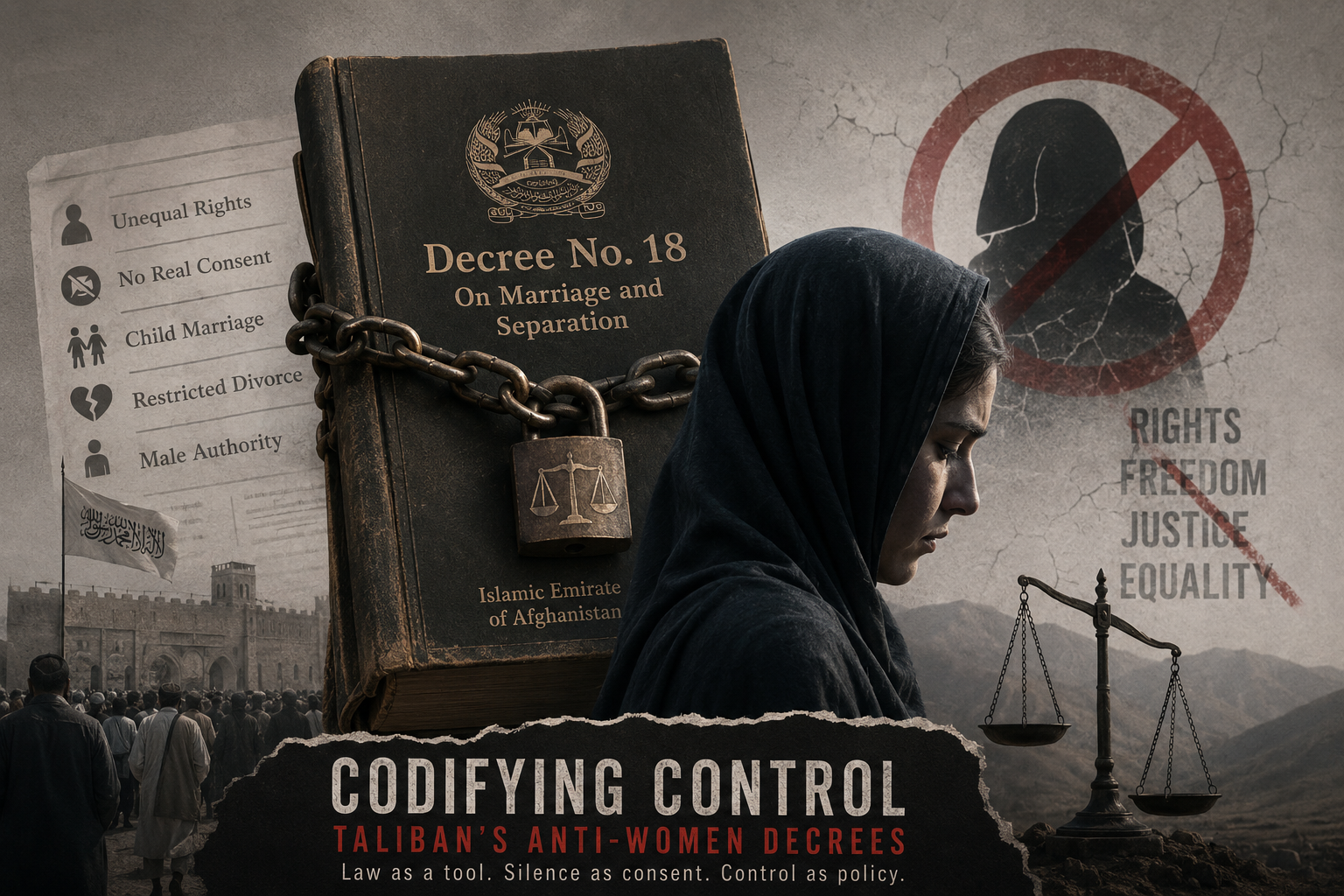
A new Taliban decree on marriage and separation reinforces unequal legal rights for women, tightening restrictions around consent and divorce.
Earlier this month, the Taliban’s Ministry of Justice quietly published Decree No. 18, a 31-article legal code governing judicial separation between spouses in Afghanistan. This week, the United Nations Assistance Mission in Afghanistan (UNAMA) issued a sharp rebuke, warning that the decree “reinforces systemic discrimination” and marks “another step in the erosion of Afghan women and girls’ rights”.
The decree, approved by Taliban supreme leader Hibatullah Akhundzada, outlines various grounds on which couples may separate, including prolonged disappearance of a husband, “incompatibility”, renunciation of Islam, or “failure on the part of the husband”. At first, the decree appears to create legal mechanisms for women seeking separation. In actuality, however, it formalises a deeply unequal system where men continue to retain unilateral divorce rights, but women must navigate restrictive and highly conditional judicial procedures to leave a marriage.
Some of the decree’s most alarming provisions concern minors and child marriage.
Article 5 allows marriage contracts concluded on behalf of a “minor boy or girl” by relatives other than the father or grandfather, provided the spouse is deemed “compatible” and the dowry customary. While the decree technically permits annulment upon reaching puberty through court approval, the very existence of such provisions effectively legitimises child marriage under Taliban rule. UNAMA explicitly noted that the decree “implies that child marriage is permitted”.
Even more troubling is the gendered distinction embedded within the decree. It sets out different standards for boys and girls in their agency to annul a marriage upon reaching puberty. In the case of a “virgin girl” who had earlier remained silent, that silence is later treated as binding consent, effectively stripping her of the right to challenge or reverse the marriage.
The decree also contains provisions that reveal how profoundly male authority remains embedded within the Taliban’s legal framework. In cases where a husband disappears during war, a wife may not remarry until his death becomes virtually certain and even until “the people of his generation have all passed away”. If the missing husband later reappears after she has remarried, he retains the authority to decide whether to “keep” her, divorce her, or pursue mutual separation. Such archaic provisions are indicative of a governing system in which women remain legally subordinate to male authority, even in circumstances of abandonment or prolonged absence.
Since returning to power, the Taliban have demonstrated immense vigour in dismantling remnants of the previous order, including the abolition of the Ministry for Women’s Affairs and its replacement with the Ministry for the Propagation of Virtue and the Prevention of Vice. One is left to wonder whether the Taliban’s conception of ‘vice’ increasingly encompasses the public presence of women themselves!
UNAMA describes the latest decree as part of a “broader and deeply concerning trajectory” in which Afghan women and girls are being denied “autonomy, opportunity, and access to justice”. The assessment is difficult to dispute.
Since returning to power in 2021, the Taliban have steadily dismantled women’s access to education, employment, mobility, and public life. Girls remain barred from secondary schools and universities. Women have been excluded from many professions and prohibited from entering parks, gyms, and other public spaces. Strict dress codes and morality regulations continue to govern everyday life.
UNAMA notes that Decree No. 18 must be understood within the wider context of measures affecting women’s rights since the de facto authorities took power in 2021. An early decree in December 2021 (“Special Decree on Women’s Rights”) recognised certain protections for women, including consent to marriage and inheritance rights.
However, subsequent decrees have gradually weakened these safeguards, limiting women’s autonomy before, during, and after marriage. For instance, Decree No. 12 (2026) introduced only restricted judicial intervention within marriage, and solely in cases of severe physical abuse, with a 15-day prison sentence prescribed for husbands convicted of serious violence.
Taliban spokesperson Zabihullah Mujahid dismissed criticism of the decree as hostility towards Islam and defended the authority of fathers and grandfathers to enter marriage contracts on behalf of children, provided they act “kind and healthy”. He also insisted that the Taliban prohibit marrying girls without their permission.
But the issue lies precisely in how “permission” is being defined. The concept of permission is rather hollow when silence can be treated as consent, and legal systems overwhelmingly privilege male authority.
The Taliban continue to frame these policies through the language of religion and tradition. Yet across much of the Muslim world, legal frameworks have evolved to recognise women’s agency in marriage and prohibit child marriage. What we see in Afghanistan, however, is political control exercised through law.
The cumulative impact of these decrees is profound. A girl denied education today may tomorrow enter a marriage arranged on her behalf, struggle to object, and later face severe legal barriers if she seeks separation. Each restriction reinforces the next, creating a system where dependency is not incidental but institutionalised. This is why growing numbers of activists and observers increasingly describe Afghanistan’s trajectory as that of gender apartheid.
The danger for the international community is that such measures gradually become normalised through repetition. Another decree. Another restriction. Another expression of concern. Meanwhile, the legal apparatus of exclusion continues to harden.
Afghanistan’s humanitarian and economic crises cannot be separated from this broader assault on women’s rights. A country cannot meaningfully stabilise while systematically excluding half its population from education, work, public life, and increasingly even personal autonomy within marriage itself.