




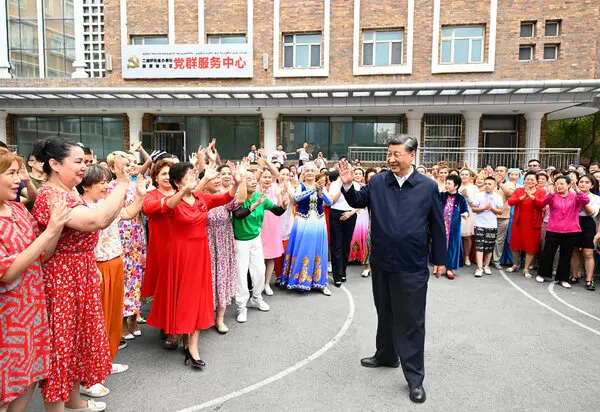
Xi’s visit to Xinjiang was as much a commemoration of history as it was a projection of China’s future direction.
Chinese President Xi Jinping’s visit to Xinjiang on September 24, 2025, carried both symbolic and strategic weight. His arrival coincided with the 70th anniversary of the establishment of the Xinjiang Uyghur Autonomous Region, an occasion Beijing marked as a milestone of continuity and progress.
In Urumqi, Xi attended a themed exhibition charting seven decades of transformation. He described Xinjiang’s development as a “vivid reflection of the historic process of national rejuvenation” and affirmed that the system of regional ethnic autonomy “is entirely correct.” The setting highlighted how the region’s past and present are intertwined with China’s broader journey.
Xinjiang: A Region of Strategic Depth
Bordering Central and South Asia, Xinjiang holds a unique place in China’s national map. It is home to multiple ethnic groups and serves as a gateway for trade, energy, and connectivity with neighboring regions. Over recent years, Beijing has underscored Xinjiang’s role in strengthening western frontiers and advancing cross-border cooperation.
Governance and Stability
The “CPC Guidelines for Governing Xinjiang in the New Era” provide the foundation for the region’s policy framework. They stress social stability, ethnic unity, the rule of law, and border security as guiding principles. The Party frames these as essential for long-term peace and as cornerstones of national strength.
Economic Growth and Connectivity
Xinjiang has been positioned as a hub of high-quality development and opening up. Exhibits in Urumqi highlighted industrial products and trade routes, reflecting Beijing’s drive to integrate Xinjiang into domestic and international economic networks. The emphasis on expanding ports and corridors signals the region’s growing role in China’s westward economic engagement.
Improving Livelihoods
Alongside infrastructure and trade, poverty alleviation and better living standards have been key priorities. Displays of revitalized markets and anti-poverty efforts underscored improvements in daily life. Official narratives link rising wellbeing with broader social stability, presenting development as a shared achievement.
Unity and Shared Identity
Ethnic unity was a prominent feature of the anniversary commemorations. Exhibitions celebrated cultural harmony and the idea of a common national identity. The Party’s vision of “uniting the Chinese Nation as one community” reinforces Xinjiang’s place within the wider project of integration and rejuvenation.
Conclusion
For Beijing, Xinjiang’s 70-year journey is framed as proof of how governance, development, and cultural integration can reinforce one another. Xi’s presence in Xinjiang underscored the Party’s confidence in the path taken over the past seven decades. The 70th anniversary served not only as a commemoration of history but as a statement of direction linking stability, development, and unity into a single narrative. For China, Xinjiang’s evolution is presented as both a regional success and a contribution to the national story of rejuvenation.
Source: China Daily