




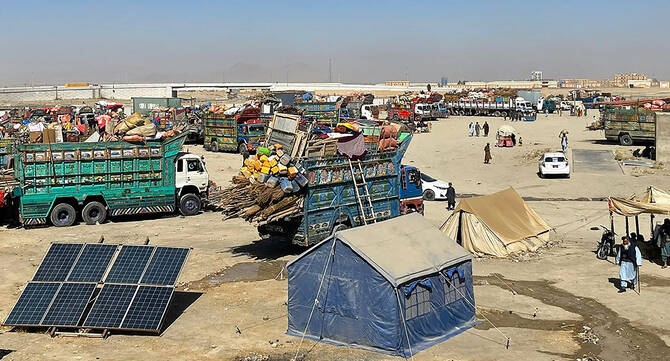
As border closures and deportations continue, thousands of Afghan refugees remain trapped between Pakistan and Afghanistan—caught in a crisis not of their making. The author notes that political estrangement has turned the Pak–Afghan conflict into a human suffering and urges both governments to prioritise compassion over coercion.
Along the road from Jamrud and Azakhel to Torkham, thousands of Afghan refugee families have been stranded for weeks – caught between two states and denied the right to move. Their trucks, laden with the remnants of their lives, have become makeshift shelters as they wait for a border that remains closed.
For nearly twenty days, both the Torkham and Chaman–Boldak crossings have been shut following recent border unrest, halting trade, transit, and the movement of people. According to the Afghan Embassy in Islamabad, over 400 trucks carrying returning refugees are stranded on the Pakistani side, facing severe hardship. Among them are women, children, the elderly, and the sick – enduring cold nights without shelter, food, or medicine. In recent days, several deaths, including those of children, have been reported due to exposure and lack of access to basic necessities.
The humanitarian situation is worsening. Pakistan’s deportation of Afghans continues even as the main crossings remain sealed. Public announcements in several towns urge landlords and shopkeepers not to rent to Afghans or provide them refuge. Reports from various districts point to arrests, harassment, and extortion, with refugees forced to pay bribes to avoid detention or deportation.
For decades, Pakistan hosted millions of Afghans displaced by war – an act of generosity that has no parallel in history. But this legacy now risks being diminished by measures that punish those least responsible for the political breakdown between Kabul and Islamabad. If the intent is to pressure the Taliban authorities to act against militant groups, such steps are misguided and could be counterproductive in the long term.
The current approach – closing borders while enforcing deportations – has created a situation that compounds human suffering. Those wishing to return home cannot do so; those remaining live under constant fear. This policy impasse threatens to turn a political disagreement into a humanitarian crisis.
Afghan Ambassador to Pakistan, Sardar Ahmad Shakeeb, has urged that crossings such as Torkham, Chaman, Angoor Adda, and Ghulam Khan be reopened, or that deportations be temporarily suspended until safe passage is possible. The United Nations High Commissioner for Refugees (UNHCR) and other humanitarian agencies must also strengthen their assistance, providing shelter, water, food, and medical care to those stranded along the roadside.
He also noted that, despite the political tensions, many Pakistanis have shown remarkable generosity. In Jamrud and Chaman, local communities have opened their homes and shared food with those in need. Their response is a reminder of the decades-long goodwill and cordiality between the peoples of the two countries.
With winter approaching, the need for action cannot be overstated. The lives of thousands of vulnerable Afghans depend on an immediate and coordinated response.
The crisis at the Pakistan–Afghanistan border illustrates the human consequences of political estrangement. Both Kabul and Islamabad must recognise that their differences, however complex, should not come at the expense of innocent lives. Borders may define sovereignty, but they must not erase humanity. It is time for both governments to protect the vulnerable when pursuing their political objectives, and to let compassion, not coercion, guide their policies.