




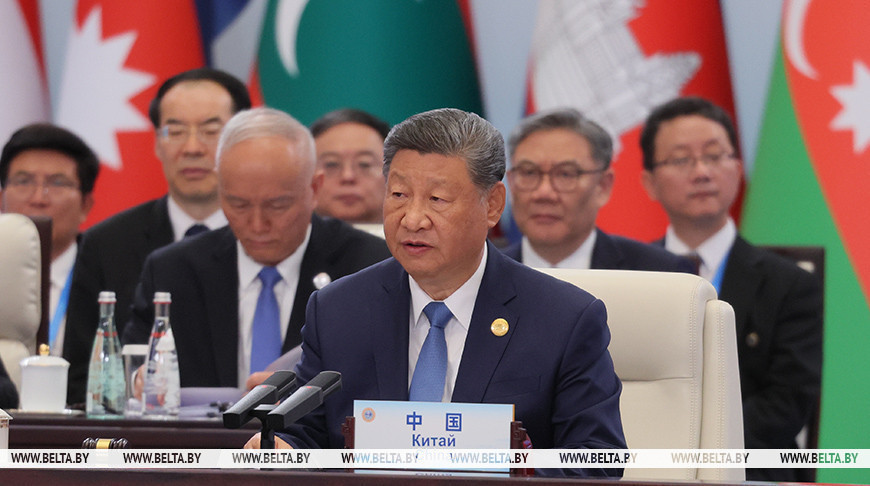
Some 24 years into existence, the Shanghai Cooperation Organization (SCO) today boasts 26 members, with the ambition of launching a common win-win economic and security cooperation framework as well as a mutually-beneficial bank to take care of the collective ventures or needs of individual member countries. The SCO increasingly resonates President Xi Jinping’s advocacy for a multi-polar, inclusive and mutually respecting world.
The joint Tianjin Declaration after the SCO 2025 summit also bears several trappings of the Chinese spirit and political philosophy– peaceful dispute resolution, inclusion, fairness, justice, cooperation, mutual respect and balance in relations with others. It reflects a remarkable blend of accommodation and care for issues that concern us all – a forum that underscores the need for a multilateral world where nations engage with one another as equals, a world not divided between the Western exceptionalism and those in the Global South many of whom are suffering the consequences of the exceptionalism.
The Tianjin Declaration underscores the urgency for a global multilateral order that must be based on justice and international humanitarian law. Those who violate these basic principles must be censured and not rewarded for use indiscriminate force in violation of the international law such as Israel’s brutal genocide in Gaza. It is literally getting away with an unprecedentedly brazen and systematic elimination of Palestinians.
“Member states condemned acts causing civilian casualties and humanitarian disasters in Gaza,” according to a statement published by Xinhua news agency, adding that they called for a “comprehensive, lasting ceasefire and unhindered humanitarian aid,” says the Declaration.
One of the finest balancing acts that the Tianjin Declaration performed relates to both India and Pakistan; “Member states strongly condemned the terrorist attack in Pahalgam on April 22 2025…Member states also strongly condemned the terrorist attacks on Jaffar Express on March 11 and in Khuzdar on May 21, 2025.
This clearly explained Beijing’s strong craving for accommodation and inter-regional cooperation through dialogue and its readiness to help mediate bi-, or multilateral conflicts.
President Xi’s call for a Global Governance Initiative – that dovetails Xi’s previous four big ideas i.e. Global Security Initiative (GSI -April 2022) , Global Civilization Initiative ((GCI -March 2023) Global Artificial Intelligence Governance Initiative (GAIGI- October 2023), and Global Development Initiative (GDI- September 2021) – stands out as yet another clarion call for setting “the house in order.”
Xi Jinping’s Four Global Initiatives are in fact set of interconnected policy frameworks that he propounded to reshape global governance and promote a more multipolar international order.
Leaders in countries such as Pakistan and in the African continent must ask themselves why China – itself a staggering example in governance and development – particularly in under-developed regions such as Laddakh, Xinjiang, Tibet – would initiative something on governance?
Isn’t it a shot at democratic despots and military leaders of some SCO member countries to focus on governance and development if they want to stand tall in the world ?
Pakistan’s present governance regime – both in the center and in provinces – is screaming for a rule-of-law-based governance but a courtier bureaucracy is out to please some of the self-serving, narcissist rulers on financial resources half of which are literally borrowed money – loans.
The message out of Tianjin is: sovereignty, salvation from unilateral exceptionalism and long-term, sustainable financial autonomy lies in good governance at home as well as multi-lateral external cooperation anchored in mutual respect for the sovereignty of partner nations. This is the path China pursued with success and SCO members can draw inspiration from it to survive as self-respecting nations.