




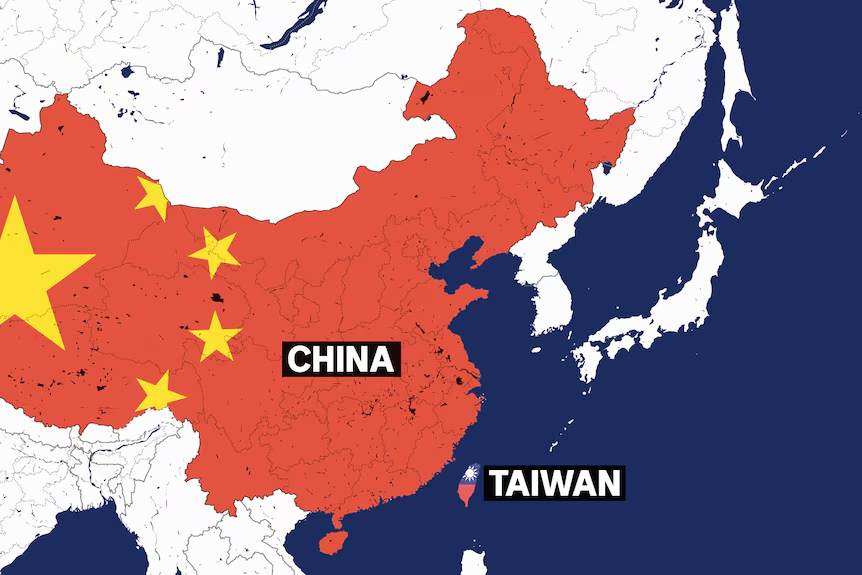
In rare strong words, Beijing has once again rejected the Treaty of San Francisco as “illegal” that cannot alter the fact that Taiwan remains an “inalienable part” of China.
Foreign Ministry spokeswoman Mao Ning made the remarks (August 18) in response to a Taiwan official’s claim that after World War II, the so-called Treaty of San Francisco replaced the Cairo Declaration and the Potsdam Proclamation, and the “treaty” did not place Taiwan under the jurisdiction of the People’s Republic of China.
See below for a background on the Cairo Declaration, the Potsdam Proclamation and the Treaty of San Francisco.
“These remarks turned black into white, distorted facts, and once again exposed the Lai Ching-te administration’s separatist nature of ‘Taiwan independence,” said the spokesperson during a Ministry of Foreign Affairs’ regular briefing.
“No matter what the Lai Ching-te authorities in (capital Taipei) say or do, they cannot alter the historical and legal fact that Taiwan is part of China, nor can they change the international consensus on the one-China principle,” Mao said, emphasizing that the complete reunification of China is an unstoppable historical trend.
She also condemned the Lai Ching-te administration for completely abandoning national integrity, disregarding the achievements of the victory in the Chinese People’s War of Resistance Against Japanese Aggression (1931-45), and “shamelessly distorting World War II history.”
“Taiwan’s return to China was an important outcome of the victory in the war against Japanese aggression and part of the postwar international order…the Cairo Declaration, the Potsdam Proclamation and the Japanese Instrument of Surrender, all legally binding international documents, unequivocally confirmed China’s sovereignty over Taiwan,” the spokesperson said, underlining that adding that Taiwan remains an “inalienable part of Chinese territory is indisputable.”
Treaty of San Francisco, Mao pointed out, was an “illegal and invalid document” concocted by the United States and certain countries after WWII, excluding the People’s Republic of China and the Soviet Union, to reach a separate peace with Japan.
“It violated the United Nations Declaration signed by 26 countries, including China, the US, the United Kingdom and the Soviet Union, in 1942, as well as the UN Charter and fundamental principles of international law,” Mao said.
What Are The Treaties?
For the sake of context, it is worth recalling what the three treaties spelt out on the status of Taiwan.
a) Cairo Declaration (1943):
A statement by the U.S., U.K., and China declaring that Japan must return all occupied territories, including Taiwan, to China.
b) Potsdam Proclamation (1945):
An ultimatum to Japan by the U.S., U.K., and China demanding unconditional surrender and affirming the terms of the Cairo Declaration.
c) Treaty of San Francisco (1951):
A peace treaty between Japan and 48 Allied countries after World War II. It officially ended the war with Japan but excluded China and the Soviet Union. That is why Beijing does not accept this as a legally binding document.
This treaty essentially laid the foundations of the western geo-politics vis a vis China and turned Taiwan into a constant point of friction in US-China relations.
But the entire Chinese leadership remains committed with an unflinching resolve to claim back Taiwan peacefully. Officials and academics say this is a dream that President Xi Jinping may also be pursuing as his generation’s service to a unified China, including Taiwan.