




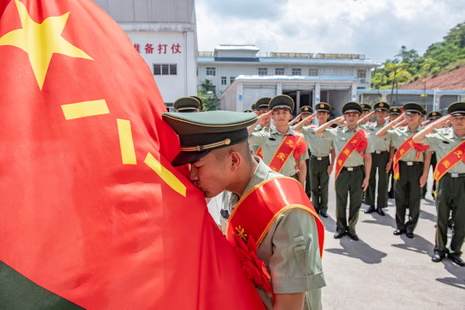
August 1 is celebrated in China as Army Day, marking the establishment of the People’s Liberation Army (PLA) during the Nanchang Uprising of 1927. Led by the Chinese Communist Party (CCP), this event is seen as the birth of the Red Army, which later became the PLA in 1948. Since then, the PLA has evolved into the CCP’s most important institution, serving both as a defender of the state and as a guarantor of Party control.
Army Day is commemorated with military parades, ceremonies, and public events, emphasizing the PLA’s loyalty to the CCP and its role in safeguarding China’s sovereignty and territorial integrity. It also highlights the PLA’s contributions to China’s revolutionary struggle, national modernization, and security framework.
Xi Jinping’s Vision for the PLA
Since taking over the CCP leadership in 2012, President Xi Jinping has consistently underscored the PLA’s importance as a professional force tasked with protecting national interests and supporting China’s global ambitions. Under his leadership, the PLA has been tasked with transforming into a “world-class” military by 2050, with basic modernization targeted for 2035.
Xi, as chair of the Central Military Commission (CMC), has pushed wide-ranging reforms aimed at restructuring, professionalizing, and consolidating Party control over the armed forces. His vision positions the PLA not only as a military institution but also as a central pillar of the CCP’s authority.
Structural Reforms
Xi’s reforms have reshaped the PLA across multiple fronts:
Organizational Restructuring (2015–2016): In 2015, Xi announced a major reorganization, cutting troop numbers by 300,000 to focus on quality rather than quantity. The seven military regions were replaced with five theater commands — Eastern, Southern, Western, Northern, and Central — to enhance joint operations among the army, navy, air force, and rocket force.
Decentralization of Dominance: A separate PLA Army headquarters was created, reducing the ground force’s historical dominance and elevating the roles of the Navy (PLAN), Air Force (PLAAF), and Rocket Force (PLARF).
Veterans’ Affairs: In 2018, the Ministry of Veterans Affairs (MVA) was established to improve the welfare and social status of military personnel, making service more attractive.
Anti-Corruption Drive: Xi launched a sweeping anti-corruption campaign within the PLA, removing senior officers accused of graft. This campaign not only addressed complacency but also allowed Xi to consolidate “absolute command” over the armed forces and push forward reforms that initially met resistance.
Impact and Challenges
These reforms have undeniably strengthened the PLA’s structure and capabilities, aligning it more closely with China’s global ambitions. Joint operations have been prioritized, command systems streamlined, and corruption curtailed. The PLA is now more outward-looking, designed to project Chinese influence beyond its borders.
However, challenges persist. Resistance to change and bureaucratic inertia remain significant obstacles. Implementing complex joint operations across multiple branches is still a work in progress. Additionally, balancing the PLA’s growing international role with domestic priorities such as social stability and political security continues to complicate China’s defense agenda.
Nearly a century after its founding, the People’s Liberation Army stands as one of the most powerful symbols of the CCP’s strength and resilience. Under Xi Jinping, it has undergone profound reforms to modernize and professionalize, while remaining firmly under Party control. Yet the journey toward becoming a truly “world-class” military will depend not only on its ability to project power abroad but also on how effectively it manages internal resistance, institutional challenges, and competing demands at home.