




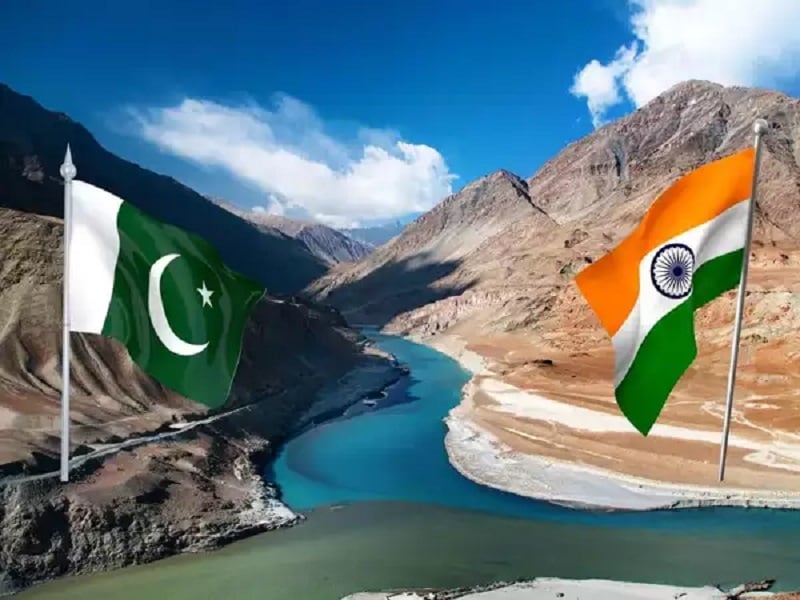
Is a two-water front crisis staring Pakistan in the face? Looks increasingly imminent if tensions with Afghanistan persist and relations with India remain frozen. After suspending the Indus Waters Treaty following the Pahalgam terror attack in April, India has now expressed support for a dam on the Kunar River. In an October 30 statement, the Indian Ministry of External Affairs said it “stands ready to support Afghanistan” in managing its water resources, including hydroelectric projects on the Kunar River, according to the Money Control website.
The announcement came just days after Afghanistan’s acting Minister for Water Resources, Mullah Abdul Latif Mansoor, announced on X that the Supreme Leader, Mulla Hibatullah Akhundzada, had ordered construction of dams on the Kunar River “as soon as possible.”
The Afghan move and the Indian support for it may have shocked many in Pakistan, but it was certainly not surprising. This moment, both tragic and predictable, has been in the making and foreseen long ago; in May 2011, Engineer Arshad H. Abbasi, through a letter to the then-president, Asif Zardari, had warned of this very eventuality — a letter that appeared in numerous international reports on Pakistan–Afghanistan water issues. That letter was not a prophecy; it was a plea, drawn from a 130-page World Bank study, “Scoping Strategic Options for Development of the Kabul River Basin” (2010).
That report laid bare the numbers. It detailed twelve potential dams in the Kabul River Basin — a total storage capacity of 4.32 million acre-feet (MAF). It warned that not all dams were feasible or necessary. The purpose of the study was to identify optimal multipurpose hydropower projects.
The Kunar River is not an ordinary water artery. Originating in the mountains of Chitral, Pakistan, it flows 482 kilometres through Afghanistan’s Kunar province before merging with the Kabul River and crossing back into Pakistan. Herein lies the irony: more than 73% of the Kabul River’s total flow originates from the Kunar watershed, most of which returns naturally to Pakistan. The average outflow from the Kabul River Basin into Pakistan is about 19% of the total basin flow — the lifeblood for Khyber Pakhtunkhwa’s agricultural fields, downstream up to the last plant of mangrove of the Indus River Delta. And yet, dams are planned, one after another, as if the river were a captive vein of Afghanistan alone.
Back in January 2022, through a similar writing, we urged the Government of Pakistan to develop inland water transport from Kotri Barrage to Warsak Dam. It was yet another desperate attempt to draw the bureaucracy out of slumber. We pointed to the mathematics of efficiency: one litre of fuel moves 24 tons by road, 95 tons by rail, but 215 tons on water. Water transport is 80% cheaper to develop than highways, with almost no maintenance burden and an infinitesimal environmental footprint. We reminded policymakers that India’s 2016 National Waterways Act declared 111 rivers as national waterways, including the Indus (NW-46), Jhelum (NW-49), and Chenab (NW-26). India was reviving its ancient rivers as arteries of prosperity.
Our plea then was simple: navigation is sovereignty. To navigate the Kabul River from Kotri to Kabul City would not only establish Pakistan’s rightful historical water use rights but also offer an economic corridor of peace and transport. It is technically feasible and economically sound. Yet, every ministry slept through the rising tide.
When Iran acted in March 2022, it tried to sabotage the Kamal Khan Dam on the Helmand River; the world condemned it as aggression. But strip the emotion, and the act reveals something Pakistan never mustered — a fierce defence of national water rights. And when Iran-backed Taliban targeted the Salma Dam in August 2021, the dam stood unharmed, but symbolism burned. India and Afghanistan had sealed their water alliance years before, inaugurated with applause by Narendra Modi and Ashraf Ghani.
Even the corridors of the United Nations are now filled with Afghan petitions — complaints against Iran, documents on Helmand and Kamal Khan — while Pakistan’s diplomats shuffle papers, unsure which river they even represent. The tragedy is not that Afghanistan builds dams; it is that Pakistan forgot to measure its past. The concept of “average of historical use”, enshrined in international water law principles, stands as the foundation for fair sharing. Under the UN Convention on the Law of the Non-Navigational Uses of International Watercourses (1997), states must respect “equitable and reasonable utilization,” considering historical uses and population needs. Pakistan, with barely 800 cubic metres of water per capita, falls below the UN’s water-scarcity threshold, while Afghanistan enjoys around 1,700 cubic metres per person. In moral, legal, and humanitarian terms, the logic of upstream dam-building collapses.
Yet the absurdity deepens. The bureaucracy now whispers of building tunnels from Chitral to the Warsak Dam. The cost would be astronomical, the purpose unclear. What we need is flow, not fantasy. These hollow schemes only cement a larger reality: Pakistan’s water diplomacy is compromised, its scientific backbone fractured. This means that 30% of the Kabul River’s waters loss will be to upstream diversions, though it contributes roughly 16% of the total Indus Basin flow, about 21.25 MAF annually.
Afghanistan’s five river basins — Amu Darya, Northern, Harirud–Murghab, Helmand, and Kabul — make it a hydrological mosaic. Pakistan, by contrast, depends on a single basin: the Indus. When Kabul’s tributaries falter, the Indus gasps. The geography is cruel; the politics, crueller. For a nuclear-armed nation of 250 million souls, to be at the mercy of an un-recognized government’s dam projects is an absurd tragedy — a failure of foresight so monumental that history itself will grieve.
The dams on the Kabul River are not acts of development; they are acts of deprivation. They violate not just the hydrological logic of shared rivers but the moral logic of coexistence.
This is no longer a matter for ministries or memoranda. It is a matter of survival. Every dam in the upper Kabul basin – From Pakistan’s wheat fields in KPK to the Indus River Delta – amounts to a death-knell for Pakistan’s water security, simply because of Islamabad’s silence and bureaucratic incompetence.
A self-inflicted wound indeed; our own hands. Our government, the guardian of rivers, has become their gravedigger. Our bureaucracy hails treaties it hardly ever studies, and speaks of laws it never understood.
It was this bureaucratic blindness and incompetence that prompted India to suspend the Indus Waters Treaty. What once was a covenant of survival has become an obituary of negligence because Pakistan’s waters – alas – have no owners — no vision, no guardians, unlike its eastern and western neighbours who jealously guard and defend their rivers.