




A wise man once said, “The stones in the riverbed are the eggs of the mighty river… you never know when the river will come to brood her eggs. So stay away from those stones.”
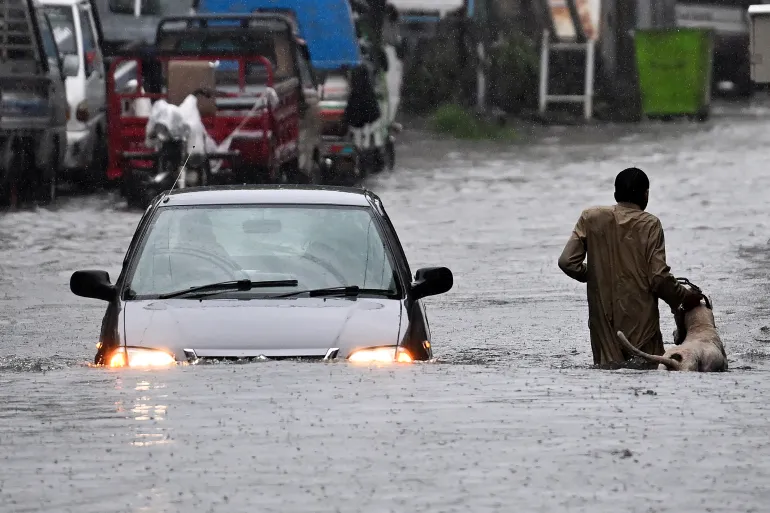
The recent floods that ravaged Khyber Pakhtunkhwa, Gilgit-Baltistan, and Azad Kashmir are yet another haunting reminder of this truth—etched not in poetry, but in water, death, and despair. Rivers, when denied their natural course, always return to claim it. But the greater tragedy Pakistan faces today is not the ferocity of nature itself. It is the betrayal of those sworn to protect citizens from predictable disaster.
After the catastrophic floods of 2010, when entire villages were drowned and millions displaced, the Federal Flood Commission (FFC) stood at a crossroads. It had the opportunity to reform, to ensure that such devastation would not be repeated. Instead, the Commission cloaked its failures with deceit. Corruption was whitewashed, poorly conceived flood structures were blamed on the vague banner of “climate change,” and the nation was soothed with hollow assurances from so-called experts who rewrote history to mask incompetence.
History itself warns us. Five thousand years ago, the Indus Valley civilization was destroyed in part by recurring floods. Yet here we are, in modern Pakistan, equipped with satellites, hydrological models, and decades of scientific progress, still allowing the same fate to repeat.
For half a century, the Federal Flood Commission has turned away from its most sacred duty: river zoning. It has never mapped the maximum flood zones of our rivers, never drawn the lines that would keep vulnerable communities out of harm’s way, never erected the protective policy barriers that could have saved thousands of lives. India carried out river zoning decades ago, identifying floodplains and enforcing restrictions. Pakistan, by contrast, waits passively—bleeding every monsoon, season after season. Our floodplains are left unguarded, open graves carved by unchecked encroachment and institutional neglect.
If the state’s abandonment were not enough, the natural defenses of our mountains have been systematically destroyed. Forests—the guardians of water and soil—have been butchered. Khyber Pakhtunkhwa once held nearly 40 percent of Pakistan’s forest cover. Today, what remains is a skeleton of stumps. Illegal logging, greed, and apathy have stripped the hills bare.
The consequences are devastating. Without roots to hold the soil and without canopies to slow the rain, the land collapses at the first assault of water. Landslides choke rivers, temporary dams form and then burst, and torrents of cascading floods rush down valleys with apocalyptic force. Villages disappear, livelihoods are obliterated, and entire families vanish into the torrent.
Forests are not just ecological ornaments. They are functional shields—sponges that absorb rain, roots that anchor the earth, and green fortresses that blunt the storm. Their destruction is not merely an environmental crime; it is a death sentence for the vulnerable. In Khyber Pakhtunkhwa, Gilgit-Baltistan, and Azad Kashmir, deforestation has turned every monsoon into a gamble with annihilation. The soil erodes, rivers clog, and waters rise—not by accident, but by deliberate human negligence.
The dangers are worsened by reckless construction. During my work in the aftermath of the 2007 earthquake, I observed firsthand how poorly planned development on steep slopes amplified the risks of floods and landslides in Khyber Pakhtunkhwa and Gilgit-Baltistan. When forests are cleared, the soil loses its ability to absorb water. Rain then rushes over hardened ground, accelerating erosion. Poorly constructed buildings, often erected without geotechnical surveys, crumble on unstable slopes during heavy rains, destabilizing entire valleys.
These lessons are not unique to Pakistan. The same pattern is evident in Uttarakhand, India, where deforestation and haphazard construction have made the region extremely vulnerable to flash floods and landslides. The parallels are striking, and the warnings are clear: when greed and negligence dominate planning, mountains turn into traps.
Yet solutions are not beyond our reach. Years ago, during the government’s proposed New Murree Project near the ancient forest of Patriata, I worked to demonstrate how technology could help safeguard fragile ecosystems. We showed officials how an electronic chip embedded in a tree could become part of a real-time monitoring system. The chip, connected to sensors, would transmit data on tree felling and location to a central command, enabling authorities to respond instantly to illegal logging. The technology was feasible, cost-effective, and already available. But political will was absent, and like so many opportunities, it was shelved.
This is the unspoken calamity of Pakistan’s environmental disasters: they are not solely born of climate change, as global narratives often suggest. They are born of betrayal—by institutions that refused to act, by leaders who chose silence over responsibility, and by the merciless axes that fell upon our forests.
The mountains still echo with the cries of those who drowned—not just in water, but in the apathy of those who might have saved them. Climate change may intensify rainfall, but it is corruption, deforestation, and reckless planning that turn storms into slaughter.
The path forward is clear. River zoning must begin immediately. Communities living in high-risk floodplains must be identified and relocated, supported by compensation and resettlement plans. Forests must be defended, not only through bans on logging but through technological monitoring systems that leave no room for evasion. Building codes in mountainous regions must be enforced, with steep-slope construction strictly regulated. And above all, the Federal Flood Commission must be cleansed of its inertia, corruption, and deceit.
Until these steps are taken, the floods will return. Each time, they will be more merciless than the last. And each time, Pakistan will mourn—not because the river is mighty, but because the nation chose weakness before it.