




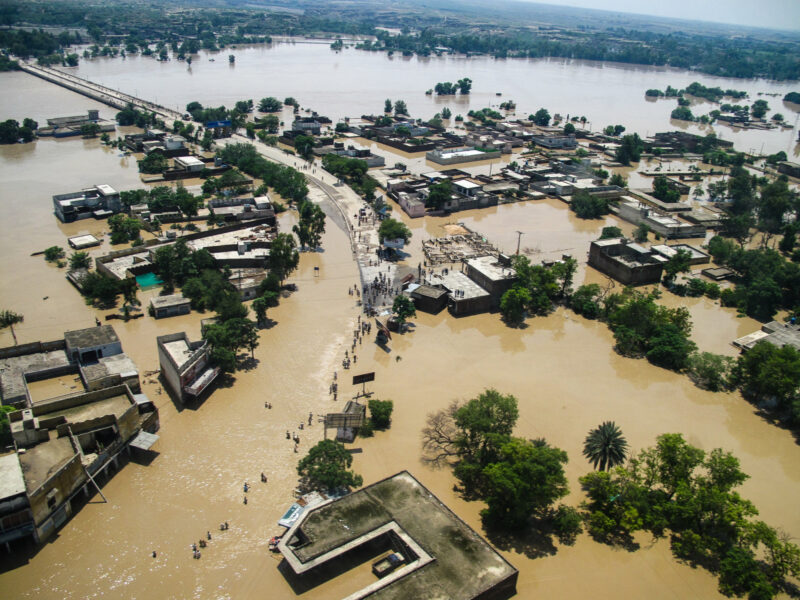
Despite accounting for less than one percent of global carbon emissions, Pakistan is facing catastrophic floods, an injustice that exposes the failures of global climate policy.
Pakistan is once again reeling from devastating floods, a tragedy that has become all too familiar in recent years. Pakistan, despite contributing less than 1% of global carbon emissions, is suffering catastrophic consequences of climate change, devastating floods, economic losses, and public health crises. Intense monsoon rainfall, amplified by climate change, has brought widespread destruction across the country, with Punjab and Khyber Pakhtunkhwa provinces bearing the brunt. Scientists attribute these extreme weather events to rising temperatures and shifting precipitation patterns, a sobering reminder of how vulnerable Pakistan is to global warming.
Since June 26, at least 645 people have lost their lives, more than half of them in Khyber Pakhtunkhwa. In just 48 hours, the province recorded 327 deaths, with Buner district alone mourning 204 lives. Over 120 people have been injured, while 50 remain missing. The scale of devastation recalls the catastrophic floods of 2022, which caused damages exceeding $14.9 billion and economic losses of $15.2 billion, crippling Pakistan’s agriculture sector and plunging millions further into poverty.
Beyond the immediate toll, the floods have unleashed a public health crisis. Waterborne diseases such as malaria, cholera, and dengue are spreading rapidly, with malaria cases reported to have increased fourfold. Relief efforts are underway: the Pakistan Army has deployed troops for rehabilitation, contributed a day’s salary to the relief fund, allocated more than 600 tonnes of rations, and tasked engineers with rebuilding bridges and setting up temporary infrastructure. Yet, the scale of destruction underscores the urgency of building long-term resilience.
This is not merely a humanitarian emergency but a stark reminder of the need for smarter climate action. International assistance is essential, but so is a clear-eyed understanding of climate economics. Too often, public debate and media coverage emphasize only the costs of climate change, without equal attention to the costs of climate policies themselves. Both must be weighed carefully if countries like Pakistan are to secure sustainable and effective solutions.
Here, the work of Yale economist William Nordhaus is instructive. Nordhaus argues that the higher the rise in global temperature, the greater the economic damage as a share of global GDP. His research shows that a worst-case warming of 7.4 degrees Fahrenheit by 2100 would reduce global GDP by about four percent. Yet, projections by the UN, OECD, and World Bank suggest that, even then, the average person in 2100 would still be over four times richer than today. In other words, climate change carries serious costs, but it is not the apocalyptic scenario often painted.
Nordhaus calculates that unchecked warming between now and 2100 could amount to $140 trillion in damages. Reducing the rise to 6.75 degrees Fahrenheit would cut the cost to $110 trillion, but the policy price tag for achieving even this modest improvement could reach $20 trillion. Greater reductions would be exponentially more expensive. His conclusion, which earned him the 2018 Nobel Prize in Economics, is that the optimal path minimizes the sum of climate damages and policy costs, not simply pursuing the lowest possible temperatures at any price.
This insight casts doubt on the effectiveness of global climate agreements such as the Paris Accord. Even if every signatory, including developing giants like China and India, met its commitments, the return on investment would amount to just eleven cents of climate benefit for every dollar spent. In contrast, Nordhaus and others suggest that a well-designed carbon tax, implemented globally and paired with the removal of costly subsidies, could deliver up to two dollars in benefits for every dollar in policy costs.
For Pakistan, the implications are clear. As one of the country’s most vulnerable to climate-induced disasters, it must continue pressing the international community for support. But equally, policymakers must recognize that the real long-term safeguard lies in innovation. History shows that human societies have always advanced by finding smarter, cheaper, and more efficient ways to solve problems. Investment in resilient infrastructure, disaster preparedness, and low-cost energy innovations will pay far greater dividends than poorly designed policies that absorb vast resources for minimal impact.
The tragedy of Pakistan’s floods is local, but its lessons are global. Climate change is real, its costs are rising, and the world must act. Yet the path forward lies not in alarmism or poorly targeted agreements, but in policies that are economically sound, globally inclusive, and rooted in innovation. Only then can countries like Pakistan hope to weather the storms ahead.