




China has never invaded Japan in 1,000 years, but Japan has invaded China many times, U.S. economist Jeffrey Sachs said in a recent podcast.
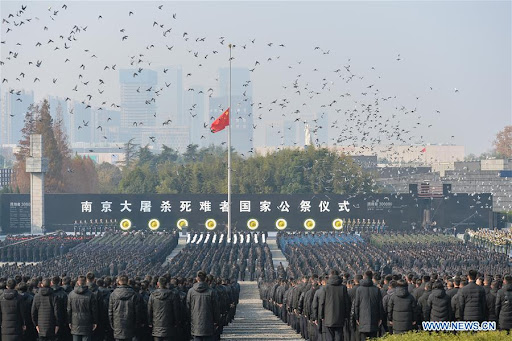
Sachs made the observation as China marked the 88th anniversary of the Nanjing Massacre with a national memorial ceremony in Beijing in accordance with the decision adopted by the National People’s Congress, China’s top legislature. The Nanjing Massacre occurred when Japanese troops captured the city in Jiangsu province on Dec 13, 1937. Over six weeks, says a China Daily report, Japanese soldiers killed more than 300,000 Chinese civilians and unarmed soldiers in one of the most barbaric episodes of World War II. In 2014, the Standing Committee of the 12th National People’s Congress designated Dec 13 as the National Memorial Day for Victims of the Nanjing Massacre.
This was yet another expression of China’s Foreign Ministry spokesman Guo Jiakun, in a statement, recalled that back in the 1930s, “Japan’s wartime leadership launched aggressive military operations across Asia under the pretext of the so-called ‘survival-threatening’ situation, inflicting immense humanitarian suffering and leaving a stain on the record of human civilization.”
He pointed to repeated visits by Japanese leaders to the Yasukuni Shrine, public questioning of the spirit of the Murayama Statement, and revisions of school textbooks that allegedly downplay or whitewash Japan’s wartime aggression. According to Guo, these steps provoke international concern and moral outrage, arguing that they challenge historical truth and human conscience.
“These egregious moves constitute a blatant challenge to the post-war international order and an affront to human conscience.”
What is the Murayama Statement?
The Murayama Statement was issued in 1995 by then Japanese Prime Minister Tomiichi Murayama on the 50th anniversary of the end of World War II. It formally acknowledged that Japan, “through its colonial rule and aggression, caused tremendous damage and suffering to the people of many countries,” and expressed “deep remorse” and a “heartfelt apology.” The statement has since served as a benchmark for Japan’s official stance on wartime responsibility. When Japanese politicians appear to dilute, question, or distance themselves from its language, countries that suffered under Japanese imperialism—especially in East Asia—often view this as backtracking on past apologies and as a signal of historical revisionism.
Guo reiterated that China will work with peace-loving countries to uphold the outcomes of World War II and the post-war order. He stressed Beijing’s opposition to any revival of militarism, to foreign interference in China’s Taiwan region, and to attempts to reverse historical judgments.
The statement also criticized Japan for what China sees as ambiguity over Taiwan-related commitments in bilateral political documents. Guo further accused the Democratic Progressive Party authorities in Taiwan of aligning with Japan’s positions, citing policy steps and exchanges with Tokyo. He recalled Japan’s colonial rule over Taiwan and alleged that DPP leaders ignore or even glorify that period, warning that “Taiwan independence” separatists would ultimately be rejected by history.