




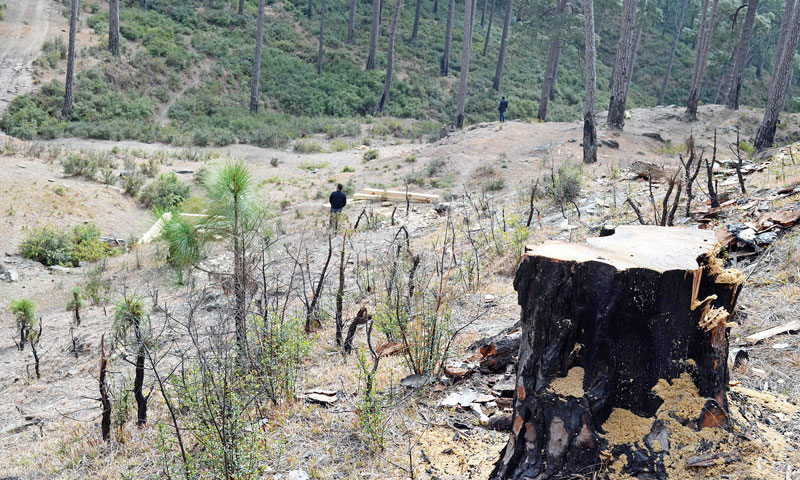
What was once the Queen of the Hills now stands as a wounded landscape, its springs silenced and its forests fading into memory.
I am neither a historian nor a political theorist. I am a professional engineer, but one with an unusual obsession: the environment and the natural conifer forests that once blanketed these mountains. Yet as a native of the Himalayas, living in the hills of Murree, I feel compelled to tell a story that is both deeply personal and profoundly urgent. Why, I ask, are the waters of the twin cities of Rawalpindi and Islamabad—and for us, the local villagers—now at stake? Why does the land once called the “Queen of the Hills” stand today on the brink of ecological collapse?
To understand, we must look at Murree not simply as a hill station, not merely as a tourist escape, but as the water tower of Pakistan. Here, the maximum rainfall of the Potohar plateau occurs. The Soan River originates in its foothills, flowing westward to sustain thousands. The Korang River, fed by streams from the Murree Hills, carries water toward Islamabad. The Haro River, too, has branches that begin in this region. And most critically, the springs of Murree recharge the groundwater aquifers that feed Rawalpindi, Islamabad, and the villages scattered across these slopes. This is not myth, nor folklore, but science. And yet, today, this entire system—the rivers, aquifers, springs, and valleys—is under mortal threat.
The seeds of this tragedy were sown not in the present century but in the year 1847. That was when British officer Major James Abbott identified Murree as an ideal summer resort for the British army. By 1849, the Murree Ridge was occupied, and in 1851, Brigadier-General Sir Henry Montgomery Lawrence formally established Murree as a hill station. One can almost picture Abbott reporting proudly to Lawrence: “Sir, I have secured for you a place of cool refuge against the summer heat.” In recognition, Abbott was promoted in 1849 to brevet major and appointed the first Deputy Commissioner of Hazara. His discovery shaped the colonial landscape of the Punjab hills, but it also began the destruction of Murree’s delicate ecology.
Unlike the local populations—whose ancestors never chose to live on snowbound ridges—the British carved out settlements on icy mountain slopes. The people of this land had always favoured temperate valleys, where winters were gentler, snowfall lighter, and water more reliable. But the British, weakened by the oppressive heat of the subcontinent, saw in Murree a retreat, and in doing so, forever altered its destiny.
And here, half in jest, let me shift the blame across the oceans. Had Willis Carrier, the American engineer, invented the modern electrical air-conditioning system a little earlier than 1902 (and not waited until 1914 to see it installed in the first residence), perhaps the British would never have been compelled to seek salvation in the hills. Had air conditioning arrived half a century earlier, Murree might have remained untouched. Shimla, Darjeeling, and Nainital, too, might never have risen to prominence. But Carrier was late, and the Himalayas bore the cost.
Abbott’s vision of Murree as a sanctuary was practical for colonial rulers but catastrophic for the land. During the British period, cantonments and bungalows were developed at Kuldannah, Barian Cantt, Clifden, Gharial, Upper Topa, and even up to the Chinar Golf Club in Bhurban. Each of these required the clearing of thick conifer forests. What was once a seamless expanse of deodar, chir, and blue pine became a patchwork of barracks, parade grounds, and golf courses. The scars of that feeling are still visible today, layered with fresh wounds inflicted by modern construction.
For centuries, springs were the beating heart of Murree. They were the source of drinking water for local households, the foundation of irrigation, and the quiet force sustaining rivers during dry seasons. Entire valleys of maize, apple orchards, and cauliflower fields once thrived on their steady trickle. But today, most springs are dead. Others are seasonal, vanishing in the very months when they are most needed. Along the Murree Ridge—from Kashmir Point to Khaira Gali and toward PC Bhurban—the veins of water have collapsed. And with them, the rivers falter. The Soan is weakened. The Korang struggles. The Haro has lost its vigour. What science now confirms, memory recalls: once, these springs kept rivers alive in winter. Now they are dry, leaving entire basins at risk.
The culprits are many, but none are natural. Deforestation, overgrazing, exploitative land use, and rampant soil erosion have stripped the land bare. Rainfall, once steady and prolonged, now comes in violent torrents. In hours, villages flood, only for the water to escape downstream, leaving nothing to recharge the springs. The shamlat lands—once common village property—have been seized by property dealers, sold to housing societies, and paved into oblivion. As a Water expert, I observed: “Whenever someone occupies the bed of a stream, the stream dies.” Murree proves this adage with brutal clarity. And the government is not innocent. Roads, buildings, and even official projects have been laid over stream beds. Every year, new link roads slice into the fragile geology, further draining the veins that once carried water.
Man-made Climate change has accelerated the tragedy. Snowfall, once five feet deep, now barely reaches one. Snow days have fallen drastically, while dry days have multiplied. Though average annual rainfall remains similar, its pattern has fractured. Where once gentle, soaking rains recharged aquifers, today short, furious bursts wash everything away. The result is cruel: either a flood in the monsoon or drought for the rest of the year. Farmers mourn their orchards and crops—apples rot, cauliflower withers. The rhythm of nature has collapsed.
Springs depend on aquifers—underground caves where rainwater is stored. When an aquifer is pierced, water emerges as a spring. But prolonged dry spells leave little time for recharge. The rain rushes away as runoff, and the springs die. Infrastructure projects have worsened the blow. Blasting for highways and hotels shatters the rock formations that guide water underground. The Murree Expressway is a case in point. Celebrated as progress, it is in fact a monument to ecological destruction. Its blasting destroyed underground channels, drying springs at their source. The impact is not confined to Murree: the aquifers of Rawalpindi and Islamabad have also been disrupted, contributing to violent spillovers in Rawal Dam, Khanpur Dam and Simly Dam, the main source of drinking water for the twin cities.
The truth is mournful and undeniable: Murree is dying, and not quietly. Its springs, once the lifeblood of these mountains, vanish before our eyes. What was once a land of steady rains and fertile valleys has become a land of floods, droughts, and thirsty villages. This is not only Murree’s tragedy. It is Pakistan’s. For if Murree—the water tower, the cradle of rivers—collapses, then so too will the plains that depend upon it.
Who will save Murree? Not merely for its cool air, nor its tourism, nor even its forests—but for its waters. If the springs die, Pakistan will be forced to consider the unthinkable: uplifting water from the Indus River, pumping it more than 800 feet uphill at a cost of no less than 3 billion dollars. Can a fragile economy afford this burden? Or will we instead choose the wiser path: to protect what remains, to restore what is broken, and to treat Murree not as a playground but as the fragile, life-giving water tower it has always been?
Murree is more than a hill station. It is a river’s birthplace, a spring’s sanctuary, and a people’s home. Its fate is tied not only to the villagers who still rely on springs, but to the millions in the twin cities, and to the countless more who depend on the rivers flowing outward from these slopes. The British cut the first scars. The Americans, with their late air conditioning, spared none. But today, the wounds are ours. The greed of property dealers, the negligence of officials, and the complacency of all who remain silent are the forces finishing what colonialism began. Murree is dying in plain sight. And here is the ultimate irony: Islamabad hosts countless self-proclaimed climate champions, think tanks, and ministries that issue polished reports and fiery speeches on climate change, always quick to blame the globe. Yet none look north, to the Murree Hills—the very water tower that sustains and neutralizes the climate of their own capital. The question is no longer academic. Will they act, or will they continue to talk while the springs dry, the rivers weaken, and the Queen of the Hills breathes her last?