




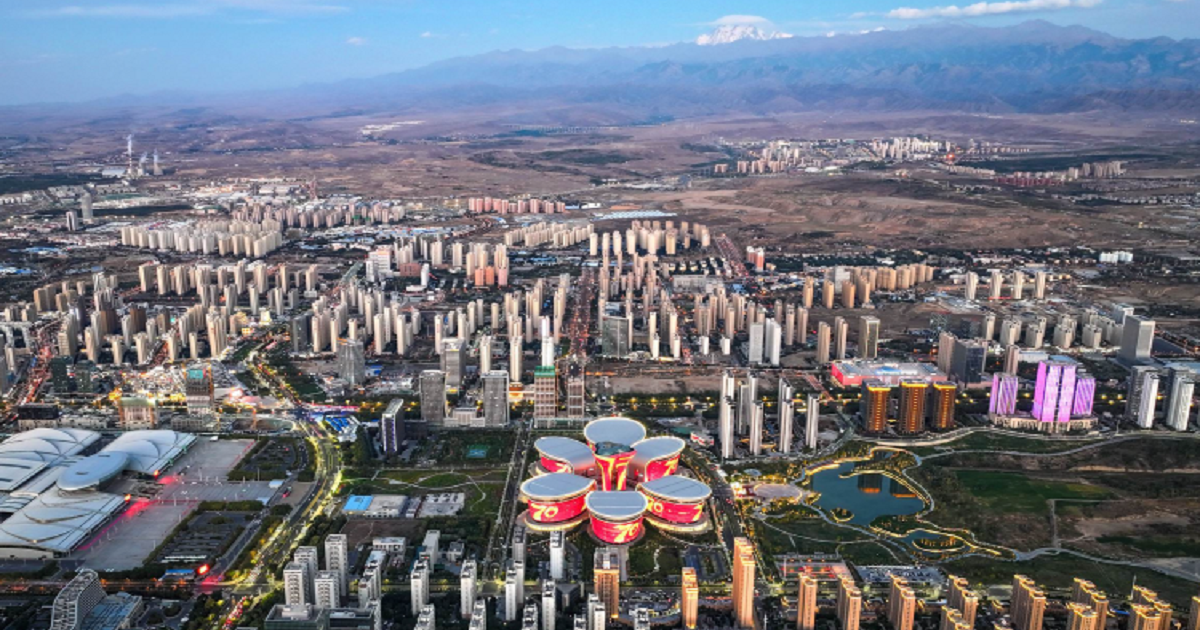
During a visit to Hotan prefecture in July 2022, President Xi Jinping called ethnic unity as the lifeline of all ethnic groups in the country. He declared all ethnic groups residing in Xinjiang as “ inseparable members of the big family of the Chinese nation.”
Empowerment of large populations of ethnic groups in regions that used to be considered as backward has been a cornerstone of China’s governance philosophy. The primary objective is to inculcate a sense of inclusion and cohesion among the local communities. That is why the autonomous regions enjoy some special legislative powers and fiscal autonomy. The special status guarantees that the local ethnic communities can follow their own cultures, language and practices their religious beliefs.
China has five autonomous regions: Inner Mongolia, Ningxia Hui, Xinjiang Uygur, Guangxi Zhuang and Xizang being the youngest addition to the group of communities that live and enjoy life according to their traditional and cultural aspirations.
The Inner Mongolia autonomous region emerged as China’s first autonomous region in May 1947, more than two years before the People’s Revolution led to the founding of the People’s Republic of China.
Encouraged by the success of the special status policy in Inner Mongolia, Beijing went on to establish four more autonomous regions – Ningxia Hui, Xinjiang Uygur, Guangxi Zhuang followed by Xizang. ????? The five regions are spread over some 4.35 million square kilometers, or more than 40 percent of the China’s total landmass.
Four of the five autonomous regions share their borders with other countries, lending them strategic importance to China’s security. The Ningxia autonomous region, nevertheless, does not share a border with another country.
The Muslim majority Xin jiang alone is spread over 1.6649 million sq-km – almost one-sixth of China’s total landmass. It borders eight countries: Mongolia, Russia, Kazakhstan, Kyrgyzstan, Tajikistan, Afghanistan, Pakistan, and India.
As a hub and core area of the Silk Road Economic Belt, Xinjiang not only serves as a gateway for China’s opening to the West but also undertakes the important mission of connecting and constructing this economic belt
Some 56 ethnic groups reside in Xinjiang. In the words of a Chinese diplomat, the ethnic, religious and cultural diversity as well as its economic opportunities have meanwhile turned Xinjiang in to a melting pot of diverse cultures and economic development that involves Agricultural cultivation techniques, livestock breeding methods, production of silk, porcelain, papermaking, metallurgy, hydraulic engineering, and gunpowder manufacturing techniques, all spread through this vital “corridor” of Xinjiang between the East and the West.
Mostly mountainous and arid in nature, these regions are not very conducive to developing agriculture and animal husbandry. That is why the combined population of the five regions is small in comparison to the territory; a little more than 110 million, half of which lives in the Guangxi Zhuang autonomous region alone. As for their combined GDP, it is equivalent to that of Zhejiang, a well-off eastern coastal province.
An ancient Confucian thought has always guided China’s development policies; you cannot progress if your neighbourhood is backward and unstable. This thought served as the driver of a policy that the Communist Party adopted for the socio-economic development of the less-developed autonomous regions.
President Xi often uses the term “rejuvenation” when talking of the need for inclusive development. The nation’s rejuvenation, he says, is not possible without developing the less-developed regions. Social infrastructure – health, education, and employment opportunities for all are some of the salient features of the policies that Beijing has been pursuing.
That is why all these regions have seen unusual rapid development ever since Xi became the party boss in 2012. Under his watch, the central government has allocated significant investment funding in the autonomous regions.
Daily life in Lhasa – the capital of Tibet, or Urumqi, Xinjiang’s capital or its sister city Kashgar on the old Silk Route – and the economic infrastructure there are living proofs of the extra attention these regions have received in the last 15 years or so.
According to a China Daily report, Xizang, for example, topped the list for per capita transfer payment from the central government to local authorities In 2024, Ningxia stood fourth, Xinjiang fifth, Inner Mongolia seventh and Guangxi 13th.
Environment protection, education and skills development and expansion of industrial base for greater productivity seem to pay dividends as far as quality of life in these regions is concerned. Though many still struggle for a quality life but the larger picture is one of greater prosperity, connectivity with, and mobility across the rest of the country. This became possible only because the central authorities have been pouring billions of yuan into public welfare and infrastructure projects.
Breathtaking infrastructure development and opportunities – despite largely inhospitable conditions because of difficult topography – in China’s autonomous regions certainly offer lessons for developing nations. Even the Laddakh region – divided between India and China – presents stark contrasts, with the latter having transformed this mountainous terrain through special initiatives.