




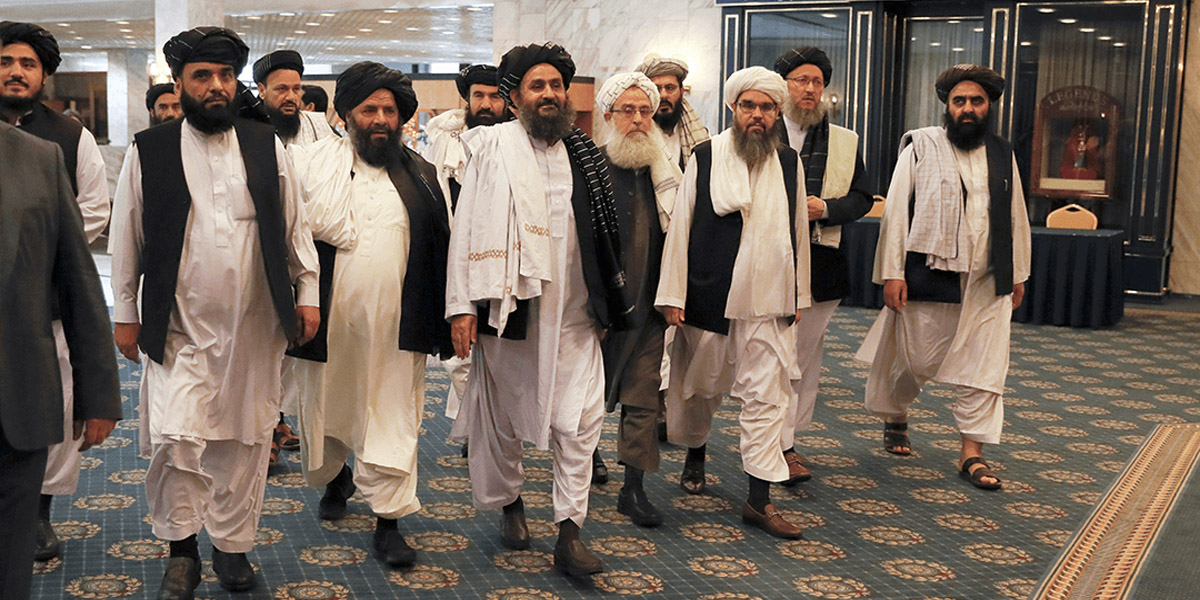
Understanding the Afghan Taliban today requires revisiting the personality and legacy of Mullah Omar.
The past four years of Taliban rule in Afghanistan have been marked by a curious silence around the life and legacy of Mullah Omar. For any careful observer of Afghanistan’s politics, this silence is striking. Mullah Omar was not an ordinary warlord of the kind that Afghanistan has seen in abundance. As Bette Dam’s The Enemy Unseen vividly shows, he was the reluctant leader of an organic movement who gradually came to overshadow both the movement itself and every other leader in Afghanistan.
During the early years of the US invasion, the imprint of Mullah Omar’s personality on the Taliban movement was widely underestimated. In the final years of his rule, Mullah Omar had come to assume the aura of a divinely chosen leader for the Afghan nation. Understanding this aura requires looking closely at the defining trait of Omar’s leadership: his uncompromising stubbornness. Critics often describe it as myopia, but even his adversaries acknowledged the force of his convictions. This stubbornness became most visible in the events leading up to the US invasion of Afghanistan after 9/11.
Different researchers, including Bette Dam and Pakistan’s former Ambassador to Afghanistan, Syed Abrar Hussain, have documented these moments in detail. Abrar Hussain’s eyewitness account of Mullah Omar’s meetings with Pakistani and Saudi envoys regarding the expulsion of Osama Bin Laden offers a telling illustration of Omar’s mindset. During one such meeting, Omar reportedly ridiculed the Saudi intelligence chief for proposing that Osama be extradited. The exchange became so acrimonious that Saudi Arabia eventually cut off diplomatic ties with Afghanistan. This happened despite Osama’s repeated violations of Omar’s instructions and warnings from Taliban leaders that he had become a liability.
It was this very personality—unyielding, distrustful of external pressure, and convinced of its own moral certainty—that shaped the Taliban movement and its leadership culture.
In this context, the transfer of leadership from Mullah Omar to Mullah Baradar takes on particular significance. As described by Bette Dam, the moment occurred in the basement of Omar’s residence in Kandahar. Among the small circle of confidants present, Mullah Baradar was the only one allowed to carry his weapon inside the meeting. The gesture was more than a sign of battlefield camaraderie. It reflected a level of personal trust that went far deeper. For Mullah Omar, Baradar was not merely a loyal lieutenant. He was a kindred spirit. Omar appeared to see in him someone capable of carrying forward not only the movement but also the stern decisiveness that defined his own leadership. In Baradar, he found a successor who could embody the same unflinching resolve.
Fast forward to today’s Afghanistan, and one finds an uncanny resemblance between Mullah Omar’s stubbornness over Osama bin Laden and the current regime’s stance on the Tehrik-i-Taliban Pakistan (TTP). Within the Taliban leadership, Mullah Abdul Ghani Baradar stands out as one of the most visible advocates of a policy marked by indifference to Pakistan’s and other regional countries’ concerns about militant groups operating from Afghan territory.
The deterioration of bilateral relations between Pakistan and Afghanistan can be attributed to many factors, but Baradar’s rigidity remains one of the less visible ones. A telling episode occurred during Pakistan’s Deputy Prime Minister Ishaq Dar’s first visit to Afghanistan in April last year. Just hours before the visit was due to begin, Mullah Baradar reportedly backed out of a confirmed meeting with him. For Afghanistan’s Deputy Prime Minister for Economic Affairs to withdraw from a meeting centered largely on trade issues amounted to a significant diplomatic rebuke. The visit might easily have been postponed. Instead, due largely to Ishaq Dar’s personal initiative and diplomatic handling of the situation, the trip went ahead. It later paved the way for two additional visits in quick succession, including the signing ceremony of the Uzbekistan–Afghanistan–Pakistan railway project and the trilateral meeting involving China, Afghanistan, and Pakistan.
Baradar’s absence from these high-profile engagements stood in stark contrast to his presence at other major diplomatic events. To many observers, this absence signaled a degree of disdain toward Pakistan or its ruling elite. The wave of negative commentary in Afghan media and the ridicule directed at Ishaq Dar following these visits reinforced that impression.
Baradar’s approach toward Pakistan is shaped by more than just ideology. One factor often overlooked in discussions of Pak-Afghan relations is his long and reportedly harsh incarceration in a Pakistani prison. In recent years, Afghan commentators have circulated vivid descriptions of the poor health he allegedly suffered during his imprisonment. Whether these accounts are entirely accurate or not, the experience itself forms part of the historical baggage that continues to influence perceptions within the Afghan leadership.
Baradar’s role within the Taliban’s internal hierarchy also reinforces his prominence in shaping policy toward Pakistan. He is widely seen as one of the most influential figures among the movement’s hardliners, alongside figures such as Abdul Qayyum Zakir, Molvi Tajmeer, Abdul Hakim Haqqani, and the supreme leader Mullah Haibatullah himself.
As a result, many of the Taliban government’s confrontational moves toward Pakistan have come to be publicly associated with Baradar. These include the recent closure of border crossings and the ban on the import of Pakistani medicines. During the February 2025 standoff at Torkham, Baradar reportedly went so far as to call for the construction of a concrete wall at the crossing if Pakistan continued what he described as its policy of arbitrary border closures. Subsequent developments have shown that such statements were not merely rhetorical. Under Baradar’s watch, the guiding principle appears to be what many Afghans describe as “Aks-ul-Amal” — a policy of tit-for-tat.
In the immediate aftermath of the Taliban’s takeover of Kabul in August 2021, there was considerable excitement about the emergence of “Taliban 2.0.” Many observers speculated that a younger, media-savvy generation of leaders would adopt a more pragmatic approach toward regional and global politics. Four years later, much of that optimism has faded. The Taliban’s rigid positions on governance and human rights have drawn widespread criticism. From Pakistan’s perspective, however, the most troubling issue remains the Afghan Taliban’s disregard for concerns about the TTP and the group’s violent campaign.
Mullah Baradar’s inherited persona offers an important lens through which to understand this stance. At the same time, it operates alongside ideological sympathy for the TTP and the complex internal power dynamics of the Kabul regime. Even so, Baradar’s posture remains the most visible expression of this mix of ideology and obstinacy.
So when one asks why the Afghan regime continues to follow such policies, the answer may lie in the continuity of leadership culture within the Taliban movement itself: “Omar is dead – Long Live Baradar.”