




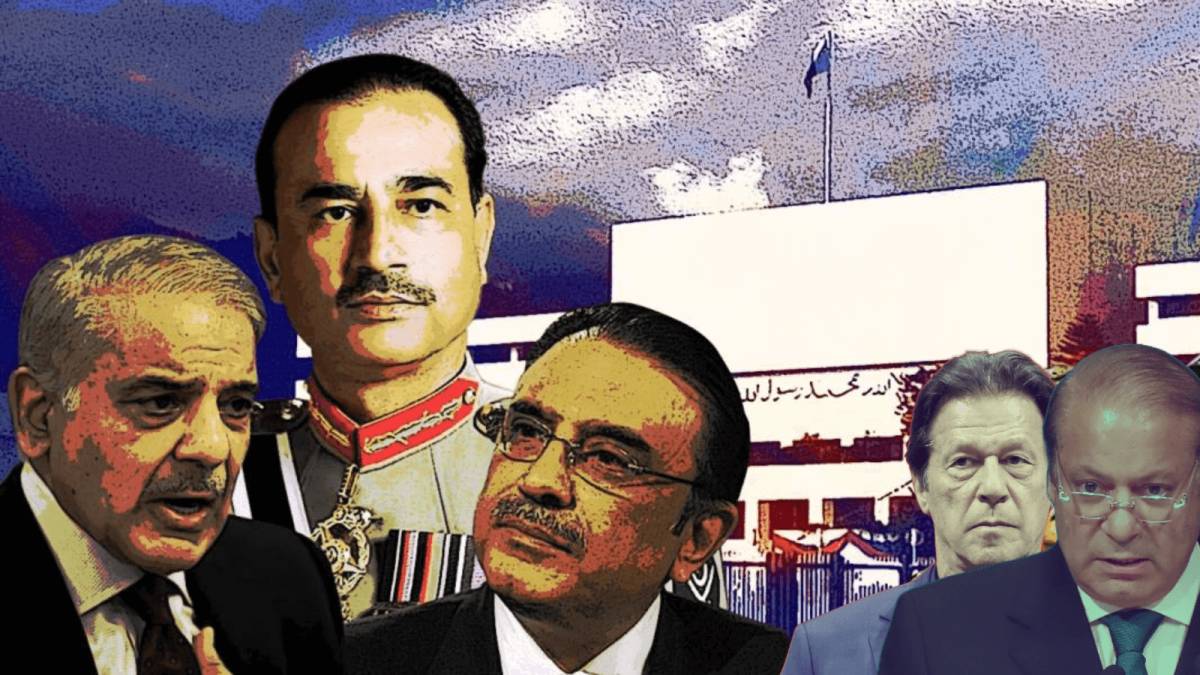
Pakistan’s promise of democracy and progress remains trapped in a cycle of power, debt, and instability.
Pakistan’s politics has always moved under the shadow of despots, and for thirty-seven years, the country was directly ruled by them. Civilian governments and institutions have stayed in place on paper, but they have stayed weak. When institutions are weak, neither democracy nor economic growth can hold for long. The system keeps hanging in the middle, not collapsing, but never allowed to grow either.
Pakistan was meant to be a democratic republic with leaders who would build strong institutions, uphold justice, and give dignity to the people. That promise never turned into reality. Politics here keeps running in the same loop: elections, derailment, restoration, relapse. The cycle repeats, and nothing moves forward.
A Nation in Two Modes
From the start, Pakistan has lived between fragile political setups and almost thirty-seven years of direct military rule. Every time democracy returns, it comes with hope, and every time it ends, it reminds everyone who has actually held power all along.
Growth Without Roots
Ironically, Pakistan’s economy grew faster under authoritarian rulers than under elected governments. The numbers show average GDP growth of around 6.3% in those years, compared to about 4.2% under democratic periods. But this kind of growth didn’t build anything long-term. It grew without inclusion, without reform, and without strengthening institutions. It left the economy dependent on foreign money instead of its own productivity.
Democratic governments walked into a setup already weakened. Institutions were hollow, politics unstable, and the result was short-term decisions and more external loans. From 2008 to 2018, during the PPP and PML-N years, GDP went up by more than two hundred percent — but external debt also doubled. The growth came from loans, not from any real innovation or structural change.
The Debt Spiral
Debt has become the most enduring symbol of Pakistan’s economic story. By mid-2025, gross public debt had climbed to Rs 80.5 trillion — a 13% jump in just one year.
External liabilities stood at around US$86 billion, with China as the largest bilateral lender, holding close to US$29 billion.
Yet most of this debt did not build schools, hospitals, or institutions.
It paid for deficits, interest payments, and the basic cost of keeping the system afloat.
In 2021–22 alone, Rs 3.7 trillion was added simply because the currency lost value — borrowing done not for development, but to plug the holes caused by economic erosion.
The pattern repeats itself: borrowing creates a brief sense of movement, but pushes the burden forward.
Growth rises, then slips; debt increases, then rolls over; reform is talked about, then pushed aside.
Talent Drain
Pakistan remains a country rich in talent and potential. Its entrepreneurs, professionals, and young people continue to excel across the world.
But every period of non-democratic rule has triggered a heavy outflow of skilled people.
In the past four years alone, nearly 3 million Pakistanis left in search of safety, respect, and a life with stability.
Final Thought
At this point, the lesson stands out: real progress does not come from GDP charts or foreign loans. It comes from institutions that can survive beyond personalities, accountability that does not expire with a government, and leadership that can govern without fear.
And a question still hangs in the air: if this land was carved out as a space for power, control, and ambition, then who will speak for the millions who were lost in the great migration?