




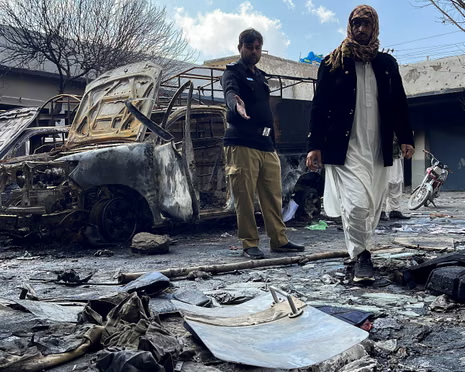
Following the January 2026 attacks in Balochistan, media narratives emerging from Afghanistan have drawn attention to the strategic role of discourse in shaping regional perceptions. This article examines the tone and framing adopted by select Afghan outlets and explores how such narratives intersect with questions of non-interference, militancy, and bilateral trust. It argues that responsible media engagement is critical to preventing further escalation in an already fragile regional environment.
“Words can be like tiny doses of arsenic: they are swallowed unnoticed, appear to have no effect, and then after a little time the toxic reaction sets in.”
In conflict environments, such words — amplified through media narratives — often become instruments of strategic signaling. In the aftermath of the large-scale militant attacks in Balochistan on 31 January 2026, the evolving media discourse in Afghanistan has added a new dimension to already strained Pakistan-Afghanistan relations.
A noticeable feature of coverage across several Afghan television programs — including discussions aired on Tolo News and Shamshad TV between 31 January and 2 February — as well as commentary circulated through affiliated social media accounts, has been a sharply critical framing of Pakistan’s internal security policies. Some commentators adopted language that appeared sympathetic toward Baloch militant groups, particularly the Baloch Liberation Army (BLA). This has generated debate in policy circles regarding the consistency between Afghanistan’s declared foreign policy principle of non-interference and the tone of certain media narratives emerging from within the country.
From an ideological standpoint, this rhetorical positioning is notable. Baloch militant groups have historically maintained a largely secular ethno-nationalist orientation, which contrasts with the Taliban’s religious-political framework. In earlier phases of the Afghan conflict, some Baloch separatist elements were reported to have maintained ties with segments of the former Kabul administrations, largely due to shared strategic opposition to both the Taliban and Pakistan. The current media framing, therefore, appears less ideological and more strategic, suggesting that broader geopolitical considerations may be influencing narrative positioning.
A further point of contention concerns the characterization of Baloch militant actors. Documented attacks attributed to the BLA and associated groups include violence against civilian targets, including Punjabi laborers and Chinese nationals linked to China-Pakistan Economic Corridor (CPEC) projects. Incidents ranging from the killing of Chinese engineers in Gwadar in 2004 to subsequent suicide bombings targeting hotels, port facilities, and academic institutions complicate efforts to frame these groups solely as political resistance movements. The civilian impact of such attacks remains a critical factor in international assessments of the insurgency.
Another dimension of the discourse involves India’s alleged role in Balochistan. Pakistan has consistently maintained that Indian intelligence networks have supported Baloch militant groups, citing the arrest of Kulbhushan Jadhav as evidence of Indian involvement in espionage activities. However, India disputes these claims. Some international research institutions, including the Combating Terrorism Center at West Point, have reported contacts between Baloch militant actors and external entities. Afghan media commentary that dismisses or downplays these allegations is viewed by Pakistani analysts as reflective of shifting regional alignments, particularly in light of recent diplomatic outreach between India and the Taliban authorities.
Beyond bilateral tensions, the Baloch insurgency has regional dimensions. The concept of “Greater Balochistan” carries transnational implications, with militant activity affecting areas of Pakistan and Iran. The April 2025 killing of eight Pakistani laborers in Iran’s Sistan-va-Baluchestan Province underscored the cross-border character of the threat. For years, both Pakistan and Iran have alleged that segments of the insurgency have benefited from cross-border mobility and informal sanctuaries in Afghanistan — a claim reflected in some international reporting, including analysis published in The Guardian referencing Afghanistan’s perceived role in aspects of the broader insurgent ecosystem.
A further concern raised by Pakistani observers is the relative absence of unequivocal condemnation from certain Afghan commentators following major attacks. While international actors, including the United Nations, issued statements condemning violence in Balochistan, Afghan media discourse in some instances focused more heavily on questioning Pakistan’s security policies than on denouncing the attacks themselves. This divergence in emphasis has reinforced perceptions of narrative asymmetry at a time when mutual trust between Islamabad and Kabul remains fragile.
It is also important to note that the insurgency in Balochistan is not monolithic. Over the years, segments of Baloch tribal leadership have engaged in reconciliation processes with the Pakistani state, leading to reintegration initiatives and localized stabilization efforts. This internal complexity is often overshadowed in cross-border media exchanges that reduce the conflict to a binary geopolitical contest.
In conclusion, the Afghan media response to the January 2026 attacks highlights the increasingly strategic nature of narrative formation in South Asia’s security environment. While the Taliban authorities deny direct support for anti-Pakistan militant groups, the tone and framing adopted by certain commentators risk being interpreted as sympathetic toward armed non-state actors operating against Pakistan. In a region where insurgencies are transnational and information ecosystems are deeply politicized, media narratives carry strategic weight. A more calibrated and balanced discourse on all sides could help prevent further erosion of bilateral trust and mitigate the risk of narrative escalation compounding existing security challenges.