




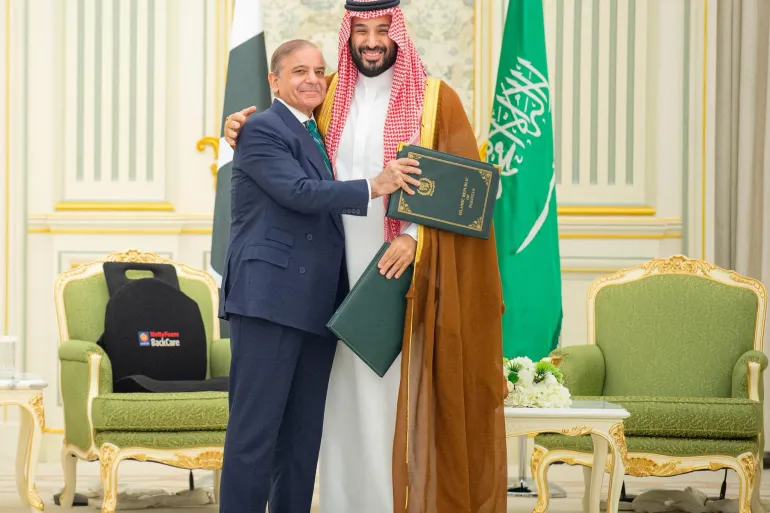
The recent Saudi-Pakistan defense pact has sparked debate about its impact on regional power dynamics and Pakistan’s evolving foreign policy direction.
The signing of the Saudi-Pakistan Strategic Mutual Defense Agreement (SMDA) in September 2025 marks a key shift in both countries’ regional strategies. Coming soon after Israel’s military strikes on Hamas in Qatar, the agreement shows how Islamabad and Riyadh are trying to redefine their roles in a region where traditional alliances no longer guarantee security. Instead, both are turning toward regional cooperation and strategic autonomy.
A Turning Point for Pakistan
For Pakistan, the SMDA signals a major departure from its cautious foreign policy. In the past, ties with Gulf states were limited to military training or symbolic gestures. This pact, however, includes a binding clause that an attack on one country will be treated as an attack on both, a clear step toward mutual defense.
Pakistan’s leadership has tried to project confidence and independence, presenting the country as a “fortress of the Muslim world.” This move reinforces that image, positioning Pakistan as a security provider rather than a dependent ally.
At the same time, the pact raises important questions. Can Pakistan sustain this level of defense commitment while facing economic instability? And how will this new alignment affect its relations with Iran, which remains cautious of Gulf-led security blocs? These uncertainties highlight the complex balance Pakistan must maintain between ambition and restraint.
Saudi Arabia’s Changing Strategy
For Saudi Arabia, the defense pact supports its broader Vision 2030 reforms, especially the aim of reducing reliance on the United States. By cooperating with Pakistan, Riyadh gains access to experienced military personnel, training programs, and defense technology.
The kingdom’s growing desire to diversify its security partnerships reflects a changing geopolitical mindset. American policy in the Middle East has been inconsistent, and Washington’s close alignment with Israel has made Gulf states reconsider their dependence on U.S. protection. Partnering with Pakistan, a Muslim-majority nuclear power with a strong military tradition, gives Saudi Arabia both flexibility and regional legitimacy. This is not a sudden shift; Pakistan has long provided security training and personnel to Saudi Arabia. The new pact simply formalizes and expands that cooperation under a clearer strategic framework.
Regional and Global Implications
The timing of this agreement is notable. The Gulf Cooperation Council (GCC) recently reactivated its joint defense system, and Pakistan’s partnership with Saudi Arabia indirectly links it to that broader effort. Over time, this could lead to wider defense collaboration with other Gulf states like the UAE and Qatar.
For Pakistan, closer ties with the Gulf also strengthen its deterrence posture against India. For the Gulf, Pakistan’s participation boosts defense capacity and shows that regional countries are capable of managing their own security.
Globally, the pact may signal a shift in regional alignments. The United States could find it harder to maintain its traditional influence, while China, with its Belt and Road partnerships with both countries, is likely to welcome the development as part of its broader regional strategy.
Economic Significance
The SMDA also carries strong economic undertones. Pakistan has been seeking Saudi investment to stabilize its struggling economy. Strengthened defense relations can reassure investors that political and security ties are solid, making Pakistan a safer destination for Gulf capital.
In return, Saudi Arabia benefits from Pakistan’s defense expertise and industrial capacity, helping the kingdom develop its own defense production base. This mutual exchange makes the pact more than just a military agreement; it becomes a partnership that blends security, economics, and long-term regional planning.
A More Independent Regional Order
In the end, the Saudi-Pakistan defense pact represents more than a bilateral deal. It points to a changing order in which regional powers are less dependent on the West and more willing to act on shared interests. Both Islamabad and Riyadh are signaling that they intend to shape their own security future rather than have it defined for them.
Whether the agreement achieves its goals will depend on how it is implemented, but it already reflects a clear shift in regional diplomacy: one that favors cooperation, pragmatism, and self-reliance over dependency and division.