




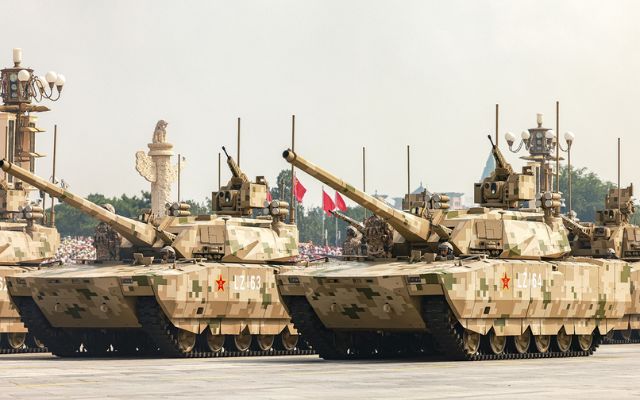
The People’s Liberation Army Ground Force’s Type 100 tank introduces true beyond-visual-range (BVR) capabilities, integrating AI, drones, and networked warfare into a single digital combat ecosystem that could redefine the global balance of armored power.
The People’s Liberation Army (PLA) Ground Force is spearheading a doctrinal revolution that could redefine the very nature of armored warfare in the 21st century.
At the center of this transformation lies the newly unveiled Type 100 main battle tank (MBT)—a platform designed not merely as a successor to the Type 99A, but as a quantum leap toward true beyond-visual-range (BVR) ground combat capability.
Unveiled publicly during the V-Day military parade in Beijing on September 3, 2025, and detailed in the PLA Daily on October 13, the Type 100 has been described as a “dimensional leap” in armored operations—one that merges air, land, cyberspace, and electromagnetic domains into a unified battlefield network.
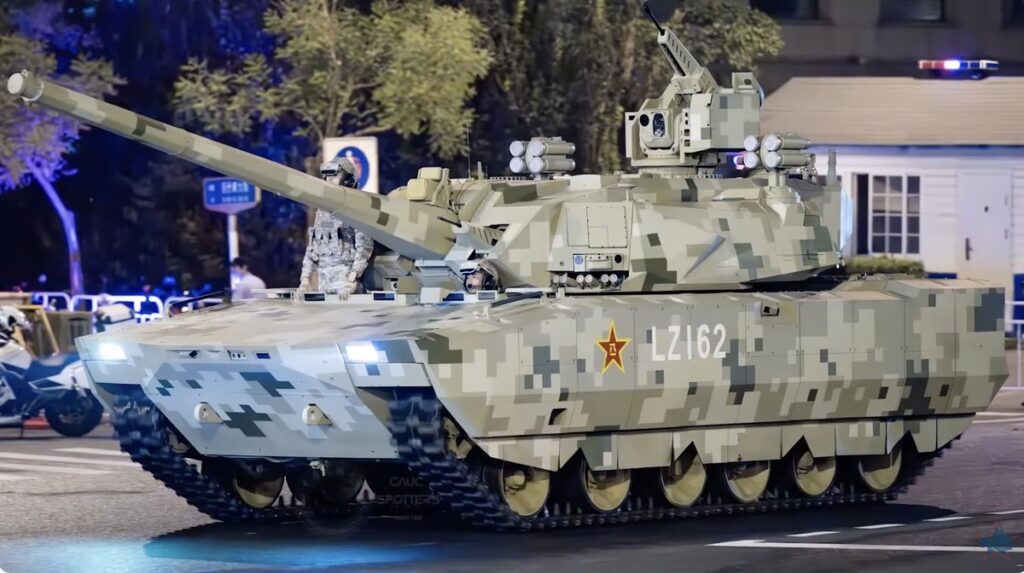
This shift marks the PLA’s emergence as the first military power to operationalize BVR combat doctrine at the ground-force level, transforming how armored formations detect, engage, and destroy targets long before direct visual contact.
For decades, the PLA’s armored warfare philosophy was rooted in Soviet-inspired, massed maneuver tactics that relied heavily on close-range direct-fire engagements.
Main battle tanks such as the Type 96 and later the Type 99A were optimized for visual-range duels, typically at distances of two to three kilometers, supported by numerical superiority and rapid maneuver.
While these systems performed effectively in traditional battle scenarios, they were constrained by line-of-sight dependencies, limiting survivability in high-threat environments saturated with precision-guided munitions and reconnaissance drones.
Since 2015, however, the PLA’s sweeping military reforms have driven the evolution of the Ground Force into a digitized, network-centric force that fuses sensors, drones, and command-and-control nodes into an integrated strike web.
This structural transformation laid the groundwork for the emergence of the Type 100—a tank designed not for dueling on open plains, but for orchestrating multi-domain, long-range, data-driven combat across vast and complex battlefields.
The Type 100: Engineered for Beyond-Visual-Range Dominance
The Type 100 represents the culmination of China’s decades-long pursuit of a “networked armored spearhead.”
Its design philosophy departs sharply from earlier generations, focusing on integration with the PLA’s broader battlefield information network, including the BeiDou satellite constellation, long-endurance UAVs, and ground command nodes.
At the heart of its BVR capability lies an array of next-generation sensors, radar systems, and AI-enabled fire-control algorithms capable of detecting, tracking, and prioritizing targets beyond the visual horizon.
Its panoramic surveillance suite—combining optical, infrared, and low-probability-of-intercept radar sensors—provides 360-degree situational awareness and real-time threat mapping.
These sensors are linked through secure, encrypted datalinks to airborne reconnaissance drones such as the KVD-200 and Wing Loong-10, which relay high-resolution targeting data to the tank’s onboard command AI.
This enables the Type 100 to engage targets it cannot physically see, using either direct-fire smart munitions or by calling in indirect fires from rocket artillery and long-range loitering munitions.
In essence, the tank functions as a network node—a battlefield “quarterback” capable of fusing intelligence from multiple domains and directing precision engagements across the tactical web.
A Revolution in Mobility, Protection, and Power Systems
Under its modular composite armor, the Type 100 boasts a next-generation hybrid-electric propulsion system that reduces thermal and acoustic signatures while dramatically increasing endurance.
This hybrid drive allows silent maneuvering in stealth operations and provides the electrical power density needed to sustain advanced radar, jamming, and sensor suites—capabilities that older diesel-powered tanks struggled to support.
The vehicle’s chassis employs an adaptive suspension system optimized for both high-speed cross-country mobility and urban combat stability, allowing seamless transitions between terrains from deserts to mountainous regions such as Tibet or Xinjiang.
Its active protection suite integrates both hard-kill interceptors and soft-kill countermeasures, including directional infrared dazzlers, millimeter-wave radar jammers, and laser-based missile deflection systems.
In addition, its unmanned turret architecture allows for a reduced crew of two, housed within an armored capsule similar to the design philosophy of Russia’s T-14 Armata—but far more digitized and AI-driven in implementation.
The crew interface, enhanced by augmented-reality (AR) helmets and 3D visualization displays, allows commanders to “see through armor” via a 360-degree virtual environment fed by external sensors and drones.
Integration with Drones and Autonomous Systems
Perhaps the most revolutionary aspect of the Type 100’s design lies in its symbiotic integration with unmanned systems.
Through its networked data links, the tank can deploy and control miniature reconnaissance drones and ground robots for surveillance, target designation, or even kinetic strikes.
In combat, the Type 100 can coordinate drone swarms to probe enemy defenses, relay targeting coordinates, and deliver precision attacks with minimal exposure to the tank itself.
This network-centric approach mirrors the PLA Air Force’s “loyal wingman” drone concept, where AI-enabled assets operate as force multipliers, extending the sensor reach and lethality of manned platforms.
The integration of UAVs effectively transforms each tank platoon into a self-contained combined-arms task force, capable of executing surveillance, electronic warfare, and strike missions independently of higher command layers.
The Doctrinal Transformation: Redefining Armored Warfare
This shift was articulated clearly in the PLA Daily report quoting tank commander Sun Yongming, who observed, “Armored operations have evolved from close-quarters brawls to beyond-visual-range engagements, and operational coordinates have shifted from a two-dimensional plane to a higher-dimensional domain.”
That statement encapsulates a seismic change in the very DNA of Chinese ground combat doctrine.
For the PLA Ground Force, this transition represents the culmination of its “informatization-to-intelligentization” roadmap—a doctrine that seeks to empower battlefield units with autonomy, data fusion, and AI-enabled decision-making.
In practical terms, BVR tank warfare transforms the battlefield into a distributed combat network, where tanks detect enemies via drones and satellites, exchange real-time targeting data, and execute precision strikes without direct exposure.
This evolution effectively minimizes traditional tank-on-tank duels, replacing brute-force clashes with algorithm-driven engagements fought through digital coordination, standoff munitions, and electromagnetic dominance.
In operational theaters such as the Taiwan Strait, South China Sea, or Himalayan frontier, this approach gives the PLA a decisive edge by enabling standoff lethality within anti-access/area-denial (A2/AD) envelopes.
AI and Electromagnetic Warfare: The Digital Battlefield
The Type 100’s battlefield dominance is not defined solely by its armor or firepower—it lies in its digital brain.
Its onboard AI operates as both a combat assistant and a decision-support system, processing battlefield inputs at machine speed to recommend optimal firing solutions, threat prioritization, and movement routes.
This AI integration extends to electromagnetic warfare (EW), where the tank can detect, jam, and spoof enemy sensors, blinding adversaries while preserving its own data links.
Its electronic countermeasures are believed to be derived from China’s expanding EW ecosystem—technologies also fielded in platforms like the Type 055 destroyer and J-16D electronic warfare aircraft.
By leveraging common architecture across services, the PLA ensures interoperability across land, sea, and air—creating a seamless joint-operations environment that amplifies the impact of every individual platform.
Global Comparison: China’s Edge Over the Abrams and Armata
The Type 100’s unveiling immediately sparked global debate among military analysts comparing it with Western and Russian counterparts such as the U.S. M1A2 SEPv4 Abrams and Russia’s T-14 Armata.
While the Abrams remains formidable in firepower and protection, its legacy architecture and crew-dependent systems limit its adaptability for AI-driven BVR combat.
Similarly, the T-14 Armata, though pioneering an unmanned turret concept, has struggled with production scale and integration of advanced sensor-fusion systems.
China’s advantage lies in its ability to combine mature digital ecosystems, domestic microelectronics, and AI research into a cohesive military framework at an industrial scale.
Moreover, the cost efficiency of China’s defense industrial base allows the mass production of high-tech tanks like the Type 100 at a fraction of Western equivalents—granting both quantitative and qualitative superiority.
This positions the PLA not only as a pioneer but potentially the global leader in ground-based BVR combat integration, with ripple effects expected across global military procurement strategies.
Strategic and Regional Implications
The strategic implications of the Type 100 extend far beyond China’s borders.
In the Indo-Pacific, its deployment could transform the land-battle calculus in potential flashpoints such as Taiwan or the Sino-Indian border, where terrain and visibility challenges have historically constrained tank operations.
For Taiwan, the emergence of BVR-capable PLA armor adds another dimension to the threat landscape, enabling long-range precision strikes from across the Strait in coordination with drones and artillery.
For India, whose armored forces still rely largely on upgraded T-72s and T-90S variants, the Type 100 underscores a widening technological gap in sensors, AI integration, and network warfare.
Across Southeast Asia, the demonstration of such capability will likely accelerate interest in indigenous and imported counter-BVR solutions, including long-range anti-tank guided missiles, loitering munitions, and EW systems.
Strategically, the Type 100 strengthens China’s concept of “system destruction warfare”—a doctrine aimed at paralyzing an adversary’s command, communication, and sensor networks before the first shot is fired.
Challenges and the Human Element
Despite its technological sophistication, the PLA still faces challenges in fully operationalizing BVR armored warfare.
Training remains the most critical bottleneck, as tank crews must adapt from conventional gunnery and maneuver drills to data-driven, multi-domain tactics requiring simultaneous coordination with UAVs and networked artillery.
This transition demands a new breed of soldier—technically literate, AI-proficient, and psychologically conditioned to trust autonomous systems in life-or-death decisions.
The PLA’s current focus on “realistic combat simulations” reflects recognition of these hurdles, as it pushes to integrate synthetic training environments and AI-based wargaming into its tank battalions.
The Global Arms Race in Digital Armor
The introduction of the Type 100 has ignited renewed competition among global powers to modernize their armored fleets for the digital age.
The United States is advancing its Next-Generation Combat Vehicle (NGCV) program, incorporating unmanned teaming and hybrid propulsion, while Russia continues to refine the T-14 with AI-assisted fire control.
European nations, led by Germany and France, are developing the MGCS (Main Ground Combat System), aimed for deployment in the 2030s with BVR networking features similar to the Type 100.
Yet, China’s ability to field such technology ahead of its rivals suggests that the balance of industrial momentum in armored warfare may already be tilting eastward.
As artificial intelligence, quantum communications, and drone swarming technologies mature, the PLA’s approach may well serve as a template for future armored doctrines worldwide.
China’s Digital Armored Vanguard
The Type 100 main battle tank symbolizes more than the next generation of Chinese armor—it represents a new paradigm in how wars will be fought and won.
By transcending the visual limits of traditional tank combat, China’s PLA Ground Force has effectively redefined the battlefield into a digitized ecosystem of sensors, data, and autonomous systems.
As the first army to operationalize beyond-visual-range tank warfare, the PLA has not only achieved a technological milestone but also set the stage for a new global arms race in intelligent land warfare.
Through the Type 100, China is demonstrating its intent to dominate not just the battlefield of today, but the algorithmic wars of tomorrow.
The decisive edge of the Type 100 will ultimately hinge on the PLA’s ability to fuse satellite ISR, long-endurance UAV feeds, and ground sensors into a resilient kill chain that withstands jamming, deception, and attrition.
If China can industrialize hybrid-electric drivetrains, active protection munitions, and phased-array sensor modules at scale, the long-term cost curve may tilt toward massed “digital armor” that saturates contested theaters faster than adversaries can field countermeasures.
Adversaries are likely to respond with dispersed anti-armor concepts built around loitering munitions, top-attack missiles, and autonomous hunter-killer UAVs cued by passive RF and acoustic signatures, forcing the Type 100 to fight under constant multi-axis surveillance and strike pressure.
The tank’s survivability will depend as much on software hardening and cyber-electronic resilience as on steel and ceramics, making continuous AI model updates, EW threat libraries, and secure datalink protocols strategic commodities.
Sustained advantage will also require a training revolution—high-fidelity synthetic environments, red-team AI opponents, and combined-arms rehearsals that validate BVR tactics, techniques, and procedures under strict emissions control and spectrum scarcity.
If these pieces come together, the Type 100 will function less as a stand-alone vehicle and more as a maneuvering command-and-fire aperture that compresses sensor-to-shooter timelines across the PLA’s joint force, converting information superiority into rapid, repeatable battlefield decision dominance.
Source: DEFENCE SECURITY ASIA