




Note: Javed Hassan has recently concluded his stint as Senior Research Fellow with Fudan University, Shanghai. This piece is based on his reflections from a visit to Chengdu, the capital of Sichuan Province
My stay in China with the Fudan University is drawing to a close, but before departing these ancient lands, I have been fortunate enough to accept an invitation from my friend Professor Huang to journey to Chengdu, the bustling capital of Sichuan Province in southwestern China.
Chengdu, a city of more than twenty million souls nestled on the fertile plains of the Sichuan Basin, has long been known as the “Land of Abundance,” a place where the earth yields richly and the people live with a certain leisurely grace amid the hum of modern progress.
Here, in this hub of western China, ancient irrigation works like Dujiangyan still tame the rivers, while the streets pulse with the energy of a metropolis that is home not only to giant pandas but also to the factories of the Chengdu Aircraft Corporation, where the advanced J-10C fighter jets are forged. These were the very weapons that, equipped with long-range PL-15 missiles, Pakistan employed with striking effectiveness in recent aerial clashes against India in the May 7-10 brief conflict.
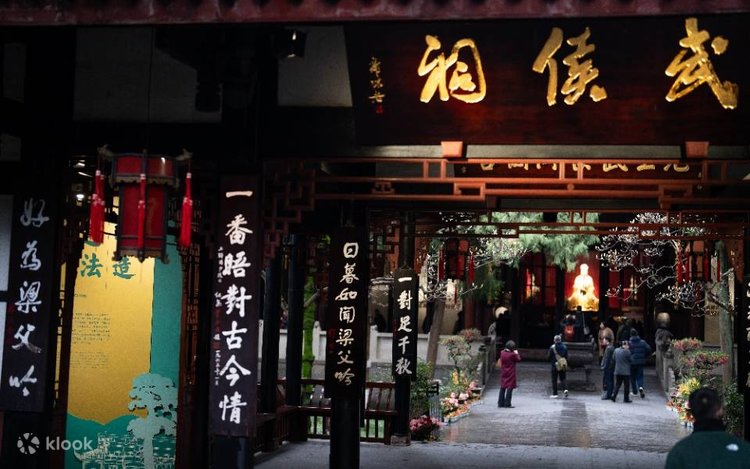
No visit to Chengdu would be complete without a pilgrimage to the Wuhou Shrine, that serene complex in the southern suburbs where history lingers amid ancient cypresses and red-walled corridors. Here stands China’s only temple jointly honoring a sovereign and his minister: Liu Bei, the founding emperor of the Shu Han kingdom during the tumultuous Three Kingdoms era, and his incomparable prime minister, Zhuge Liang.
The shrine traces its origins to the burial of Liu Bei in 223, near what is now his modest Hui Mausoleum, a simple earthen mound shaded by trees. Over centuries, separate halls arose, but in time they merged into this singular site, rebuilt in its present form during the Qing Dynasty. Yet it is known universally as Wuhou: the Martial Marquis, after Zhuge Liang’s posthumous title, for it is he who commands the deeper affection of the people.
Liu Bei was commendable in his way: a man of benevolence who thrice humbled himself at a thatched cottage to beseech the reclusive genius for aid, forging one of history’s most celebrated lord-vassal bonds. But it is Zhuge Liang, the Crouching Dragon, who has captured the national imagination, exalted in the pages of the Romance of the Three Kingdoms, that sprawling 14th-century tale which has shaped Chinese storytelling for generations. In its vivid chapters, amplified far beyond the spare historical records, Zhuge emerges as the embodiment of wisdom: the master strategist who borrows arrows with straw boats, summons eastern winds to turn battles, and governs with unyielding loyalty even unto exhaustion.
Walking these quiet paths, past inscribed couplets and beneath plaques proclaiming his name to echo across the universe, one encounters the most celebrated of all:
“If one can attack the heart, then resistance will naturally disappear; from ancient times, those who truly understand warfare do not delight in it.”
Another couplet reads:
“If one does not assess the situation carefully, then both leniency and strictness will lead to error; those who govern Sichuan in later times must ponder deeply.”_
These lines, penned and calligraphed by the Qing scholar Zhao Fan in 1902, praise Zhuge Liang’s strategic wisdom, capturing hearts rather than merely territories, as in his southern campaigns, while quietly advising future rulers to adapt policies wisely rather than rigidly. In an age of chaos, he represents the ideal of intellect and fidelity triumphing over brute power: a beacon that has endured through operas, novels, and the collective memory of a nation.
In the hush of those halls, amid the scent of incense and ancient stone, one feels the weight of that enduring legend.
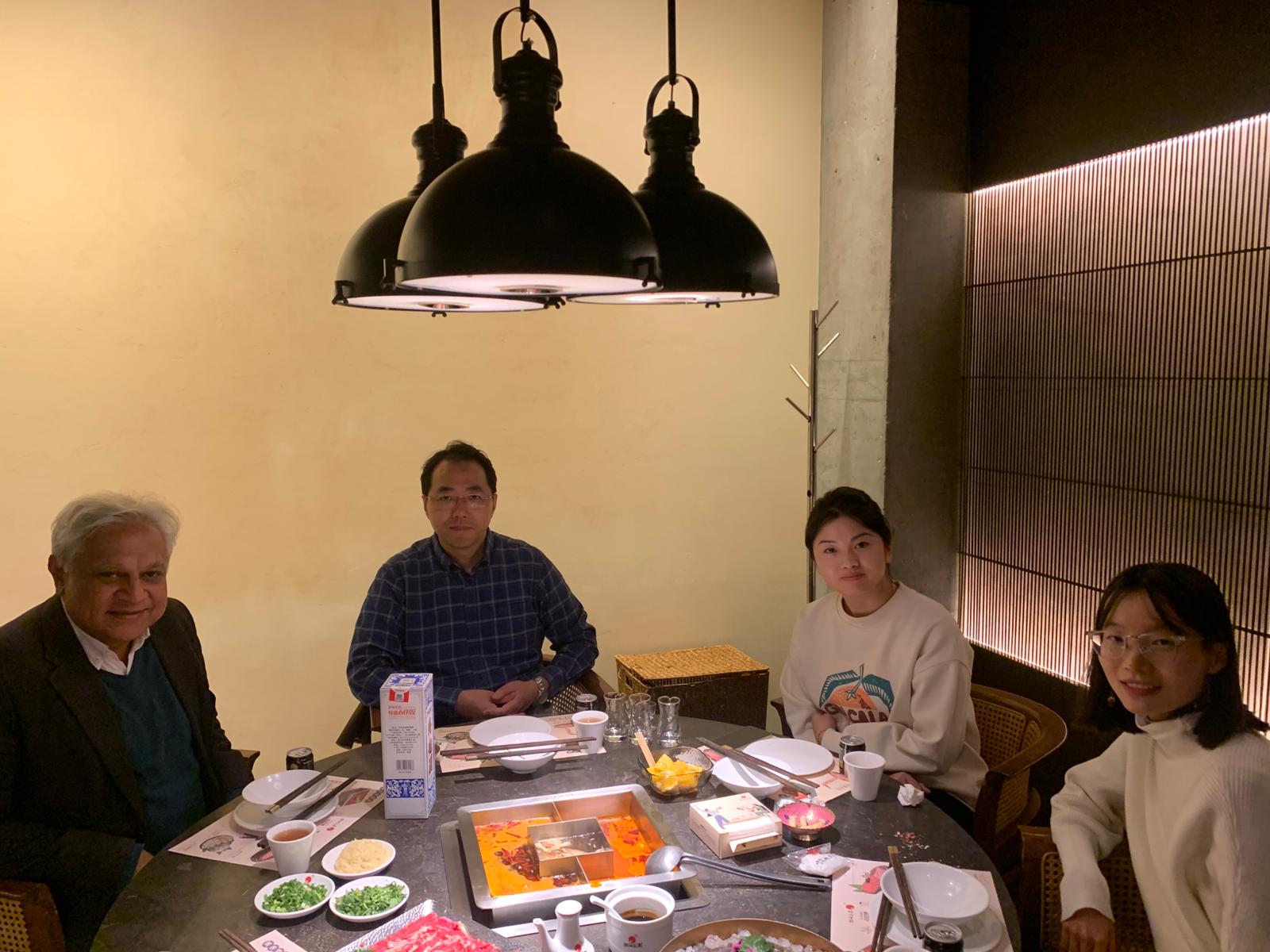
Yet beyond the meditations on Zhuge Liang’s wisdom, my most hospitable host, Professor Huang, would not permit me to leave without experiencing the renowned Sichuan hot pot, that fiery communion around a simmering cauldron which defines the soul of this province’s cuisine. We gathered with his exceptionally talented PhD candidates, one of whom spoke fluent Urdu, for a lively discussion of regional affairs around a divided pot: one side a roiling red sea of chilies, Sichuan peppercorns, ginger, garlic, star anise, and fermented beans; the other a milder broth for respite.
This was a meal worth traveling a thousand miles from Shanghai to savor. The preparation is a ritual in itself: thinly sliced beef, lamb, and offal (tripe, tongue, gizzards) plunged briefly into the bubbling brew, alongside local fish, leafy greens, tofu, lotus root, potatoes, and an array of mushrooms, including varieties that are supposedly fatally toxic when raw but, after prolonged simmering, yield a silky, aromatic creaminess that delights the palate. The fiery spices and numbing peppercorns may daunt the uninitiated, yet I found myself thoroughly relishing these challenging delicacies, each dip into the pot releasing waves of heat and flavor.
All of this was washed down with repeated toasts of a baijiu from Luzhou Laojiao, a strong-aroma “water of life” that carries echoes of fruit and earth. The bottle bore the historic “Worker and Peasant” brand (“Gong Nong Pai”), a name and design from the revolutionary era, evoking the worker-peasant alliance so central to that time. A brew worthy of Mao himself, and one which he reportedly favoured during the long-march and the confrontations in which he prevailed against the Japanese invaders and then the nationalists.
In the warmth of that steaming pot and the camaraderie it fostered, one senses the enduring spirit of Chengdu: bold, resilient, and unyieldingly flavourful.