




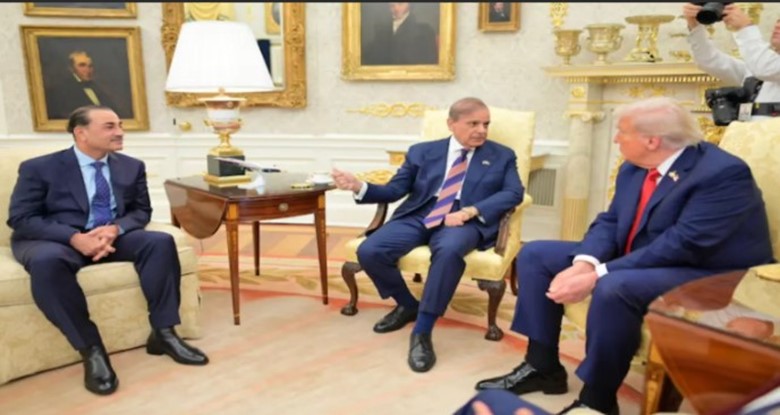
When Prime Minister Shehbaz Sharif and Pakistan’s Army Chief sat down with Donald Trump for an 80-minute meeting in the Oval Office, the silence that followed spoke louder than words. No joint statement. No official communiqué. Just whispers, speculations, and the uneasy sense that Pakistan’s top leadership had little choice but to hear, agree, and comply.
Trump is not a career politician; he is a transactional leader. His approach is blunt: every deal must have a winner, and preferably, that winner is Trump. So, what could have been the “price tag” of Pakistan’s presence in that meeting? Here are the most probable items on the hidden agenda:
1. Afghanistan Commitments
Trump’s America remains obsessed with stability—or at least control—over Afghanistan. Pakistan’s role as a gatekeeper is well known. Likely, the U.S. pressed for greater cooperation in counterterrorism, intelligence sharing, and perhaps even tacit permission for limited operational reach inside Afghan territory.
2. Counterterror Financing and FATF Compliance
The Financial Action Task Force (FATF) has long been a pressure point for Pakistan. Trump could have demanded stricter guarantees: no tolerance for “double games” on militant networks, stronger legal frameworks, and visible crackdowns to keep Pakistan off the blacklist. For Trump, this would be a low-cost, high-return move—Pakistan bends, the U.S. claims credit.
3. Defense and Security Alignments
Trump thrives on arms deals. The Oval Office conversation may have included U.S. defense hardware sales, military training programs, or alignment of Pakistan’s procurement strategy with American interests. For Washington, it is also about keeping Pakistan from slipping too far into China’s military orbit.
4. Trade Leverage and Economic Strings
Trump is transactional at his core: “You want economic relief? What do we get in return?” Pakistan, with its fragile economy, could have been pushed to make concessions—preferential trade deals, business openings for U.S. companies, or policy shifts aligning with American investors.
5. China Balancing Act
Perhaps the most sensitive of all, Trump may have sought assurances that Pakistan would not act as Beijing’s unconditional ally in South Asia. With CPEC and Chinese military cooperation expanding, Washington’s priority would be to at least slow down, if not dilute, Pakistan’s dependency on China.
6. Regional Diplomacy and India Equation
Trump could have pushed Pakistan to tone down tensions with India, especially in the context of Kashmir, to avoid complicating U.S. strategic partnerships in the region.
At this point, Professor Paul Poast, a political scientist at the University of Chicago, offers a sharp perspective: “Meetings like this often carry demands that never make it into press releases. It is very likely that Washington sought concessions tied to Pakistan’s regional posture—promises on India, assurances on terrorism, and most importantly, commitments that tilt Pakistan closer to U.S. interests and away from Beijing. The absence of a joint statement may itself be evidence that these demands were too sensitive to put on record.”
Eighty minutes is a long time in politics, but when it comes to Trump, every minute has a price. The silence after the meeting suggests one thing: whatever was demanded was too weighty to be disclosed publicly. Pakistan’s leadership may have left the Oval Office with smiles for the cameras, but behind those smiles may have been the bitter taste of concessions made in quiet submission.