




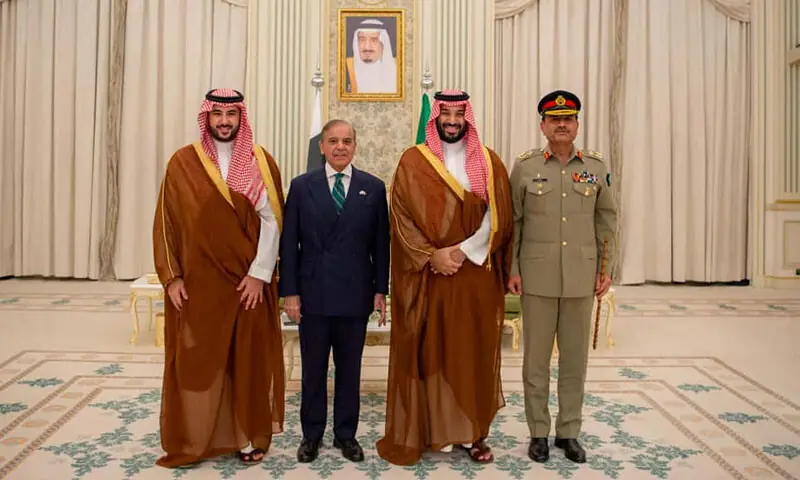
The signing of the Pakistan-Saudi Arabia ‘Strategic Mutual Defence Agreement’ is a momentous event and realigns Pakistan’s position in the geo-strategic equation. However, the announcement was a bolt from the blue, with just a few hours’ advance indication that anything of its kind was underway. Understandably, the reaction in Pakistan has been somewhat muted. Media coverage and editorial comments are somewhat non-committal and politicians – in and out of government – are generally silent. Even government ministers appear to be confused, making contradictory statements.
A few basic preliminary questions arise. The public was out of the reckoning, of course. But was the subject debated in Parliament, or was it even taken into confidence? Was the subject debated in the Cabinet, or was it just informed, and if so, before or after the decision was made? Was the President taken on board at any time?
Or was the decision taken behind closed doors? If so, it will be a repeat of the decisions made in 1979-80 behind closed doors to hop on to the United States bandwagon and join its war against the Soviet Union. Pakistan had no conflict or even a dispute with the Soviet Union and there was no threat to Pakistan from the Soviets or from Afghanistan. But, the then decision-makers had a warped sense of strategic priorities; laced, of course, with the lucrative prospect – duly fulfilled – of liberal inflow of loosely accountable dollars.
The results were – and have been – disastrous for the country and the people. The social fabric was torn and arms and drugs flooded the country; the internal political compact was ruptured, ethnic and sectarian violence seared the soul of the country, and different criminal and terrorist forces punctured the writ of the state. More than four decades down the road, the colossal damage remains to be fully repaired. The people have paid the price in blood.
Pakistan is already mired in a complex web of conflicts in South Asia. There is a simmering quarter-of-a-century-old stand-off with India on the eastern front, erupting into active war time and again, with one of them resulting in the loss of the eastern province in 1971. Post-1980, Pakistan has also entangled itself in the convoluted Afghan maze and the shenanigans of policymakers behind closed doors have continued through 9/11 up to the Taliban takeover. The result is a dangerously volatile Western Front as well. The people, including members of security forces, are paying the price in blood.
In the above context, the current decision – the Pakistan-Saudi Arabia defence pact – portends to be as disastrous as the one in 1979-80. Of course, there are muddled statements from government sources about what the Agreement says or does not say. While the de facto position is, and will for all the days and years to come, subject to interpretations, the de jure position is crystal clear. The Agreement, with the word ‘mutual’ in its title, explicitly says that an attack on one country will be deemed to be an attack on the other. This evidently opens the door to the possibilities for military engagement. Pakistan has inserted itself into the vortex of Middle Eastern politics, about which the country has little intellectual or strategic understanding or experience.
The aspect of Saudi support to Pakistan is as follows. Pakistan is in a state of military confrontation with India and Afghanistan. The idea that Saudi Arabia will go to war with India alongside Pakistan is absolutely untenable. The conflict with Afghanistan is unconventional and Saudi Arabia can only provide its economic muscle to diplomatic mediation.
The aspect of Pakistani support to Saudi Arabia is as follows. Pakistan has been providing security – without fanfare – to Saudi Arabia in various forms since the 1960s. Rightly so, there have been no reservations about it. Saudi Arabia is a true friend of Pakistan and has stood by with support in all situations, including pouring in millions of Riyals; despite knowing that their assistance is falling through large cracks.
Scanning Saudi Arabia’s external security environment, three possible threat scenarios can be surmised: one, an ongoing war, though currently suspended, with the Houthis in Yemen; two, a war with Iran; and three, an attack by Israel. The first two can draw in Pakistan militarily. Both the Houthis and Iran are Shia, and Pakistan has a large Shia population – guesstimated at about one-fifth overall and larger in ex-FATA and Gilgit-Baltistan. The internal backlash can be seriously destabilizing. The Israel factor is a wild card. Pakistan may be a nuclear power, but is it in a position to engage in a war with Israel, with its tottering economy?
Will Saudi Riyals continue to prop up the economy as US dollars have done? Will the people continue to pay the price, economically and in blood?