




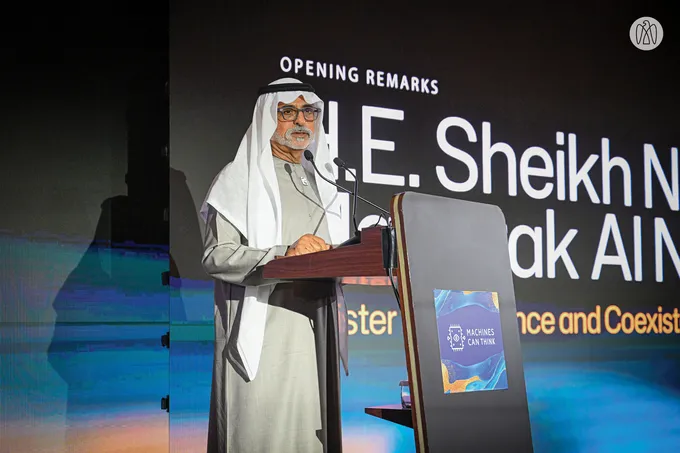
LAST week, Abu Dhabi hosted the ‘Machines Can Think 2026’ conference. Given the region’s enthusiastic embrace of AI, the availability of resources for ambitious approaches, and the openness to pursue them, I was most interested in one particular panel discussion session, titled ‘AI Classroom — Rethinking Education for the Knowledge Economy.’ The panel was attended by the provost of Mohamed bin Zayed University of Artificial Intelligence (MBZUAI) in Abu Dhabi, Timothy Baldwin, the president of Khalifa University in Abu Dhabi, Prof Ebrahim Al Hajri, the provost of New York University (NYU) Abu Dhabi, Arlie Petters, and others.
Although all three institutions represented on the panel were from Abu Dhabi and operate in the same policy environment, they are taking quite different perspectives on and approaches to the adoption of AI tools in their programmes.
Panellists’ views were the most diverging on the question of the evolving role of AI in higher education. At Khalifa University, AI tools are already being used to develop course-specific tutoring agents that can deliver individualised teaching to students. The perspective is that teaching is repetitive, hence a drain on faculty’s time, and it is more efficient to allocate more of it to research. I cannot say I entirely agree that this should or will be the best use of AI tutoring agents. Reliable, high-trust tutoring agents that can be accessed round-the-clock certainly make for an excellent additional learning resource.
However, the hope of fully or substantially replacing faculty with such agents for learning is reminiscent of promises of radical and widespread changes in education. In the early 2000s, it was distance learning enriched by lecture recordings on CDs. In the early 2010s, it was the promise of global-scale massive open online courses (MOOCs) that were going to kill universities. During Covid, some foresaw that education could now be (better) delivered online and out-of-school children were about to become a thing of the past. While these approaches have found their niche uses, removing students from the social environment that is the classroom has been, in general, sub-optimal. It is hard to see how the outcome can be much better if it is professors who are removed from the classroom.
There was also an argument for viewing AI agents as more than tutors that simplify the learning process, but something akin to maker-spaces in which learners engage with the “subject” under study for challenge and intentional struggle.
The question for universities is no longer whether AI will reshape higher education, but which parts of the academic enterprise they want it to reshape.
There was also significant variation in the pace and method of adoption of AI tools. Some have chosen a mandated adoption policy from the top down. However, NYU Abu Dhabi, developed as a liberal arts and science college, is deliberately holding back on AI adoption policies that are overly specific. Instead, it has opted for a more bottom-up direction for the flow of innovation, prioritising academic judgment and freedom of its faculty and giving them the space to experiment and pioneer uses appropriate for their discipline. Different institutions, different approaches.
A point on which participants were largely in agreement was the use of AI tools for tasks associated with teaching that are among the bottlenecks for scaling the delivery of education by orders of magnitude, eg, grading students’ work. However, while there is great interest in such applications, universities are treading carefully, rolling out policies for the ethical use of AI ranging from wide to narrow uses, some explicitly prohibiting the use for grading for major assessments (like exams).
After the initial years of euphoria around large language models, co-pilots, and AI agents, they have to start delivering applications to address use cases that yield productivity gains to justify the massive investments made in AI. Over the last few decades, many universities have seen increasing bloat in administrative headcounts and expenditure. Little wonder then that since this is where universities have been accumulating fat, it is likely to offer more opportunities for productivity and efficiency gains. Panel participants identified admissions teams as one operation where AI tools could be deployed, cutting costs and processing time.
Other possible uses not talked about at the panel but that have been identified include predictive analytics to detect disengaged students for timely interventions to enhance student retention. AI tools can be used for the complex task of optimising timetables and scheduling the use of campus facilities (labs, lecture halls, etc) by balancing availability, student demands, and faculty schedules. AI for predictive maintenance can be used for energy management systems, forecasting campus utility needs, and significantly reducing waste and operational costs.
Often, after a tragic event or another, campus security is found to have been understaffed, but that has to be balanced against converting universities into garrisons. The alternative, campus surveillance by CCTV cameras monitored by humans, can be too invasive and has been prone to abuse. AI can replace humans in that loop.
The question for universities is no longer whether AI will reshape higher education, but which parts of the academic enterprise they want it to reshape and why. The temptation everywhere is to chase efficiency, yet institutions that resist the urge to make AI merely a cost-cutting tool may find the far greater payoff lies in keeping (or making) the educational experience learner-centred and using AI to deepen, rather than dilute, the human elements of learning.
Courtesy: Dawn